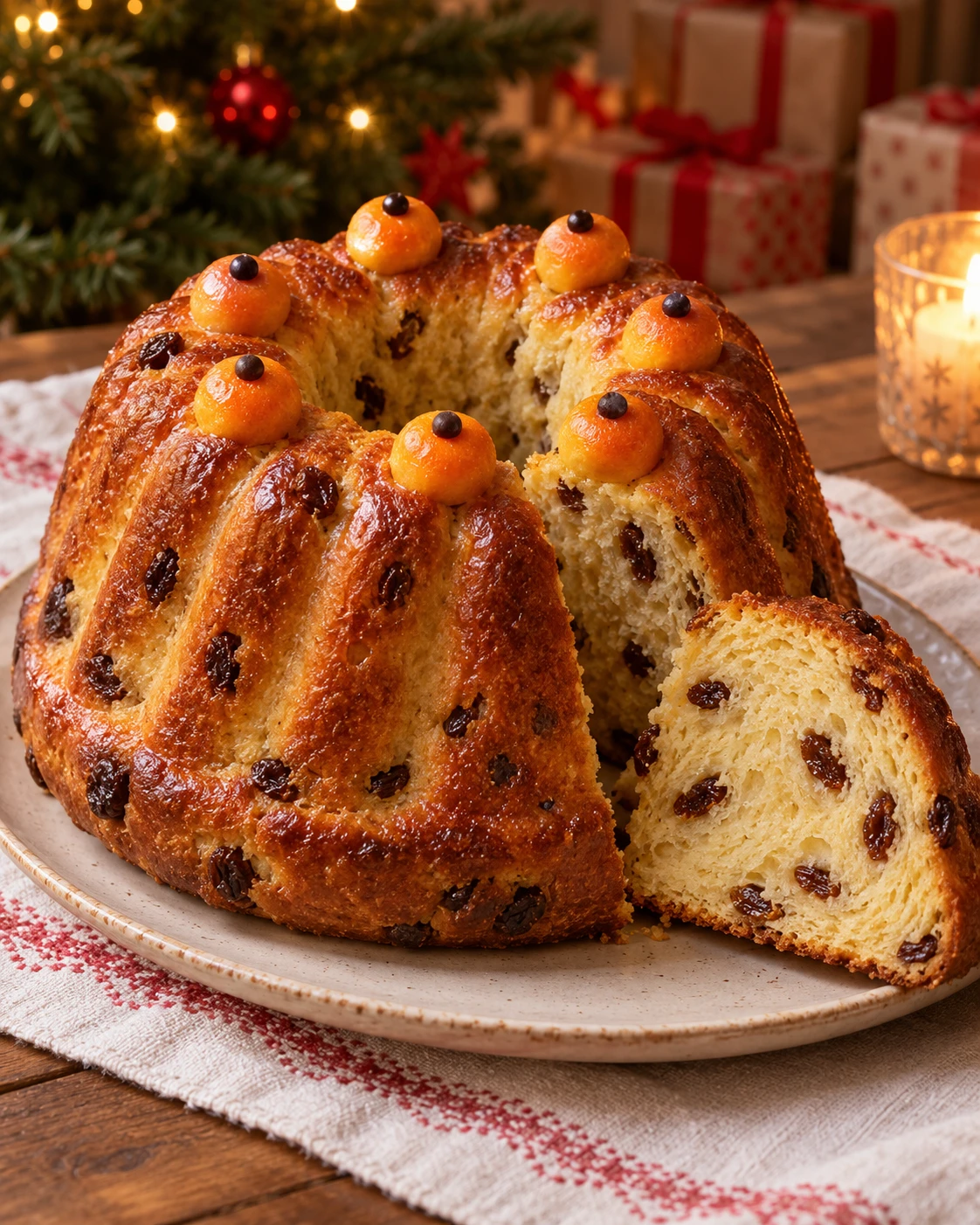
Seven-ball Portal Kugelhopf
raisins / almond / orange
Seven balls, twelve parts.
Kitchen Mode and Timer
Keep the recipe at hand during preparation.
Enables JavaScript to use the kitchen tools.
Visual Timer: Keeps this page open. It does not sound an alarm. The cooking remains to be monitored.
That's all you need!
Equip me with a pack.If you miss something, choose your ingredients from Monoprix and your utensils on Amazon. Adjust the quantities to your guests, then uncheck what you already have.
Choose the number of guests and uncheck what you already have at home.
This sheet indicates a yield in parts or in weight. Specify your basis for calculating the races.
Your selection contains only the checked items. Check products and availability at Monoprix for ingredients, on Amazon for utensils.
Amazon Affiliate Links. As an Amazon Associate, I earn from qualifying purchases.
Your choices are memorized on this device.
It's up to you.
15 detailed steps, from preparation to service.
Prepare the raisins and separate the butters
Pour 100 g of raisins into a bowl and cover with warm water for 20 minutes. Drain them in a strainer and then spread them on a clean cloth or absorbent paper and carefully dab: the soaking water does not go into the dough. Weigh separately the 120 g of soft butter from the dough and the 20 g for the mould.
Prepare milk, yeast and eggs
Measure the 120 ml of milk and make them cool to about 30 ° C, never burning. Check on the bag if the 7 g of dry yeast must be rehydrated; if so, do it in this milk according to the package leaflet, without adding any liquid. Break 2 eggs one by one in a small bowl, remove any piece of shell, then beat them with a fork for 20 to 30 seconds to mix white and yolks. Cut the 120 g of butter from the dough into small dice.
Gathering the ingredients of the dough
Pour 350 g of flour into the bowl of the robot with the hook or into a large bowl. Add the 70 g of sugar and 4 g of salt, mix quickly and then pour the milk, yeast and the two beaten eggs. Start at a small speed, or with a spoon by hand, to moisten all the flour before kneading.
Knead before adding butter
Crocheted about 8 minutes at slow to medium speed, stopping once to scrape the bottom. By hand, fold the dough on itself and then push it with the palm for 10 to 12 minutes. It must become more consistent and begin to stretch; do not add flour simply because it sticks a little more.
Gradually add the 120 grams of butter
Add the butter cubes three times. Wait until the first portion is almost absorbed before adding the next one, then continue the kneading about 8 minutes to the robot, a little more by hand. The dough may seem to break down at first: continue without adding flour. Stop when it is soft, slightly shiny and stretches without tearing immediately.
Stir in the raisins and let rise
Add the drained and well-dried raisins then kneaded just enough to distribute them, about 1 minute. Gather the dough in the centre of the bowl, cover it and leave to rise in a temperate room, around 24 °C, for about 1 hour 30 minutes. Find the starting level on the bowl: the dough should approximately double in volume, even if it takes a little longer.
Butter the splines and place the almonds
During this rise, use the reserved 20 g butter to coat the entire inside of the 22 cm kouglof mold, including the chimney and grooves. Use a clean brush or fingers. Spread the 20 whole almonds at the bottom: place one in each groove, then the remaining ones between the first if the mold has less than twenty grooves.
Degassing and putting in the mold
When the dough has doubled, press it once or twice with the palm to chase away the big bubbles. Gather it in a ball, open a hole in the center with your fingers and widen it to pass the chimney of the mold. Remove the crown without tearing the raisins and spread the dough all around with your fingers. The level should be as regular as possible.
Leave for the second rise
Cover the mold without tightening and lets rise about 1 hour at low temperature. The dough must swell up to three-quarters of the height of the mold; the volume is a better marker than the exact minute. Towards the end of the rise, preheat the oven to 175 °C, conventional oven setting (no fan), with an oven rack in the bottom third.
Cook the kouglof and control the crumb
Remove the cover and bake for 35 to 40 minutes. The top should be gilded; push a skewer into the heart of the thickest part, away from a grape, and check that it comes out without sticky paste. If the top is coloring too fast, cover it slightly with baking paper. Do not take out the cake on the sole criterion of color if the interior remains pasty.
Unmoulding without breaking the crown
Place the hot mold on a stable surface and wait 10 minutes. Place a wire rack on it, hold the whole with oven gloves and then return with an assured gesture. Lift the mould gently; if it resists, wait a few more minutes without pulling on the brioche. Allow to cool for about 1 h 30 on the rack before cutting, powdering or placing chocolate.
Powder the brioche completely cold
Place the cold kouglof on its dish and sift the 20 g of icing sugar on the top and the grooves. Keep the fireplace open to show the crown. Prepare next to a small baking tray covered with baking paper, a scale and the ingredients of the balls: 100 g of marzipan, 10 g of food orange powder and 15 g of dark chocolate.
Form seven orange almond balls
Knead 100 g of marzipan a few seconds between the hands to soften it. Incorporate the 10 g of orange powder in two, folding and then pressing the paste until the color is even. Divides the 110 g obtained into seven parts of about 15 to 16 g. Roll each portion between the palms to form a ball and flattens its base very slightly so that it remains stable.
Draw points and book the collage
Chop 15 g of dark chocolate with a knife and put it in a small, perfectly dry bowl. Place the bowl on a saucepan containing 2 cm of barely simmering water, without the bottom of the bowl touching the water. Stir gently with the spatula and remove the bowl as soon as the pieces are almost melted; continue to stir off the heat. Wipe the bottom of the bowl before moving it: no drop of water should enter the chocolate. Reserve about half to fix the balls. With the tip of a small cone, place a single large dot on the visible face of each of the seven balls, then let it take 15 to 20 minutes on the paper. This deliberately simple decor avoids modeling tiny stars that would be difficult to remake.
Spread the seven balls around the portal
Choose seven regular positions around the hole, on parts where each ball can rest entirely on the brioche. Just remove some icing sugar from these places with a dry brush. Place a drop of reserved chocolate on the base of a ball and press it very lightly; start again for the others. Allow to freeze for 30 minutes without moving the dish, then slice between the balls when serving.
Conservation. 2 days under bell; possible freezing in slices.
Namely. Recipe proposal: follow the quantities and texture marks of the card. Indicative times. The rendering depends on the ingredients and materials used. The objects of the photographic decoration remain out of the dish.
Baking tips for this recipe
- Weigh the yeast and uses the type indicated in the recipe: yeast and yeast are not interchangeable.
- Observe the increase in volume during shoots. A cool room can lengthen the times indicated.
- Respect the dimensions of the mold and the amount of dough: a brioche too tight or too full does not cook in the same way.
Substitutions and variations
Blond or brown raisins can be used at the same weight; retains the soaking step when it is planned.
Keep the type of chocolate provided for the structure or ganache. Switching from dark chocolate to white chocolate changes the balance: the quantities do not transpose directly.
More treats for your Christmas table
Recipes that share ingredients or the same preparation family.