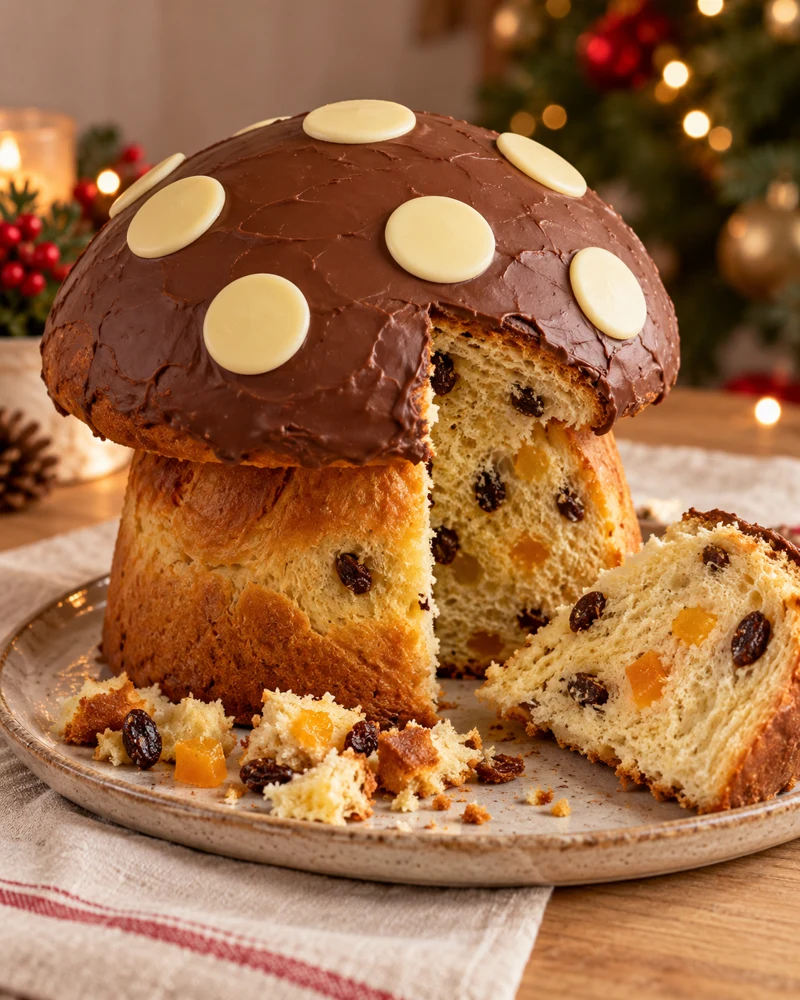
Giant Mushroom Panettone
Orange / raisins / chocolate
Under the hat, a party cake.
Kitchen Mode and Timer
Keep the recipe at hand during preparation.
Enables JavaScript to use the kitchen tools.
Visual Timer: Keeps this page open. It does not sound an alarm. The cooking remains to be monitored.
That's all you need!
Equip me with a pack.If you miss something, choose your ingredients from Monoprix and your utensils on Amazon. Adjust the quantities to your guests, then uncheck what you already have.
Choose the number of guests and uncheck what you already have at home.
This sheet indicates a yield in parts or in weight. Specify your basis for calculating the races.
Your selection contains only the checked items. Check products and availability at Monoprix for ingredients, on Amazon for utensils.
Amazon Affiliate Links. As an Amazon Associate, I earn from qualifying purchases.
Your choices are memorized on this device.
It's up to you.
19 detailed steps from preparation to service.
Prepare butter and fruit
Cut the 140 g of butter from the dough into small dice and let them soften: they must crush under the finger without being melted. Keep separate the 10 g of butter destined for the top. Weigh 120 g of raisins and 100 g of candied orange peels; cuts the peels into 5 mm cubes to distribute them in the crumb.
Take the zest and prepare the eggs
Wash and dry the untreated orange. Only grate its colored skin over a cup, without the bitter white part, then reserve the zest. Break the 3 medium eggs one by one in a small bowl, check that no shell has fallen and mix them with a fork; also prepare 1 teaspoon of vanilla.
Prepare milk and yeast
Measure the 150 ml of milk and warm it up to 30 °C, without making it hot. Read the instructions for 8 g of dry yeast: if rehydration is necessary, do it with part of this milk, taken from the 150 ml. No additional milk is added to the recipe.
Mix the first ingredients
Put 450 g of force flour or T45 and 100 g of sugar in the vat of the robot equipped with the hook. Add the beaten eggs, the milk and the yeast prepared according to its instructions, then the 5 g of salt on the side before mixing. Spin at a small speed to collect the dough and scrape once the bottom if flour remains stuck.
Knead the dough before the butter
Kneaded about 10 minutes at slow to medium speed. The paste should begin to become smooth and elastic, even if it still sticks to the bottom of the tank. By hand, works in a large bowl by lifting and folding the dough regularly; takes more time and avoids adding flour to make it artificially dry.
Add the butter three times
Divide 140 g of soft butter into three servings. Incorporate the first into the hook, wait until it disappears in the dough and then add the following in the same way. Knead for another 10 to 15 minutes: the dough must regain hold and stretch into a flexible membrane when you gently pull a small piece, without tearing immediately.
Incorporating fruits and fragrances
Pour the 120 g of raisins, the 100 g of candied orange, the reserved zest and the vanilla teaspoon into the dough. Mix at the slowest speed for 1 to 2 minutes, just to distribute the inclusions. Scrape the fruits left at the bottom and fold the dough on it, without continuing to beat for a long time after their incorporation.
Leave for the first rise
Gather the dough into a large bowl and cover it to keep the surface supple. Let rise about 2 hours in a room around 24 °C, away from drafts. The dough should roughly double in volume; if it moves slowly, prolongs the rest rather than putting it in a hot oven.
Fold and form the ball
Gently press the center of the raised dough to evacuate some of the air, then bring its edges back to the middle. Turn it over to put the folds underneath and round it with your hands. Place a 1.5 kg paper panettone mold on a plate and place the ball in it, soldered underneath, without greasing the paper.
Let rise up to two centimeters from the edge
Cover the mold slightly and leaves to rise 1 h 30 to 2 hours. The top of the dough should arrive at about 2 cm from the edge of the mold; the time depends on the temperature of the room. Towards the end of the rise, turn on the oven at 170 °C in conventional oven setting (no fan) and place an oven rack in its lower part.
Cut the top and add the reserved butter
Remove the cover from the mold. With a small sharp knife, very delicately traces a shallow cross on the top, without pressing to the point of deflating the dough. Place the 10 g of butter reserved in the center of this cross; they are distinct from the 140 g already incorporated in the dough.
Cook and check the temperature at heart
Bake the baking tray for 45 to 55 minutes. After about 25 minutes, cover the top of a sheet of baking paper if it is already well colored. From 45 minutes, push a probe into the center of the brioche, without touching the plate: aims at about 93 ° C and extends for a few minutes if necessary; the center must not remain pasty.
Cool completely in the mold
Take out the plate with oven gloves and place the panettone, always in its paper mold, on a wire rack. Allow it to cool completely for at least 1 h 30, more if the center remains warm. Do not remove the paper or cut the hot brioche: the crumb would tear and the chocolatey decor would melt on contact.
Remove the paper and locate the foot
Take off the paper from the completely cold panettone and place it straight on a board. Find the dome that will form the hat and the cylindrical part below. Measure the available width: the finished foot must keep at least 12 cm in diameter so that the fungus remains stable, directly placed on its base.
Cut a wide foot under the dome
With a bread knife, remove thin strips of brioche on the sides under the dome, about 1.5 cm deep all around. Gradually turns the cake and keeps the foot centered; do not dig under the hat to the point of weakening it. Place all the offcuts in a cup and keep a very horizontal base, without adding support.
Napper the milk chocolate hat
Chop the 130 g of milk chocolate and put them in a small, perfectly dry bowl. Pour 2 cm of water into a saucepan, heat until it simmers and then lower the heat. Set the bowl over the pan without letting it touch the water. Stir with a spatula and remove as soon as the last pieces melt. Wipe the bottom of the bowl: no drop of water should fall into the chocolate. Transfer the mushroom to its dish, leave the chocolate to cool down and spread it only on the dome with a spoon or a small spatula. Spread the 130 g in a regular layer; the foot remains naked and shows the crumb of the brioche.
Let go before the white spots
Let milk chocolate firm for about 20 minutes in a cool room. It should no longer flow when you touch the edge very lightly with a spatula. Prepare a clean and dry second bowl for white chocolate, so that the dots remain clear and do not mix with a still liquid cover.
Draw the six big dots of the hat
Chop the 60 g of white chocolate and put them in a small, perfectly dry bowl. Pour 2 cm of water into a saucepan, heat until it simmers and then lower the heat. Set the bowl over the pan without letting it touch the water. Stir with a spatula and remove as soon as the last pieces melt. Wipe the bottom of the bowl: no drop of water should fall into the chocolate. Leave to cool down and then place six small spoonfuls on the hat, spaced from each other. Spread each round irregularly with the back of the spoon, in a thin layer; keeps large areas of milk chocolate visible between them. The 60 g makes it easy to work in the bowl: harden the surplus into small pallets on baking paper to serve them with the parts, without thickening the six patterns.
Allow to be taken and served
Let the white dots take another 20 to 30 minutes before serving. Cut the mushroom with a bread knife, supporting the parts on the dish so as not to break the hat; also serve the offcuts. The brioche remains in one piece, with a wide foot, without high assembly or hidden element to make it fit.
Conservation. 3 days well packed at cool room temperature.
Namely. Recipe proposal: follow the quantities and texture marks of the card. Indicative times. The rendering depends on the ingredients and materials used. The objects of the photographic decoration remain out of the dish.
Baking tips for this recipe
- Weigh the yeast and uses the type indicated in the recipe: yeast and yeast are not interchangeable.
- Observe the increase in volume during shoots. A cool room can lengthen the times indicated.
- Respect the dimensions of the mold and the amount of dough: a brioche too tight or too full does not cook in the same way.
Substitutions and variations
Blond or brown raisins can be used at the same weight; retains the soaking step when it is planned.
To vary a zest, choose another citrus fruit washed and intended for this use, keeping the same amount. Does not automatically replace juice, whose acidity can change the preparation.
More treats for your Christmas table
Recipes that share ingredients or the same preparation family.