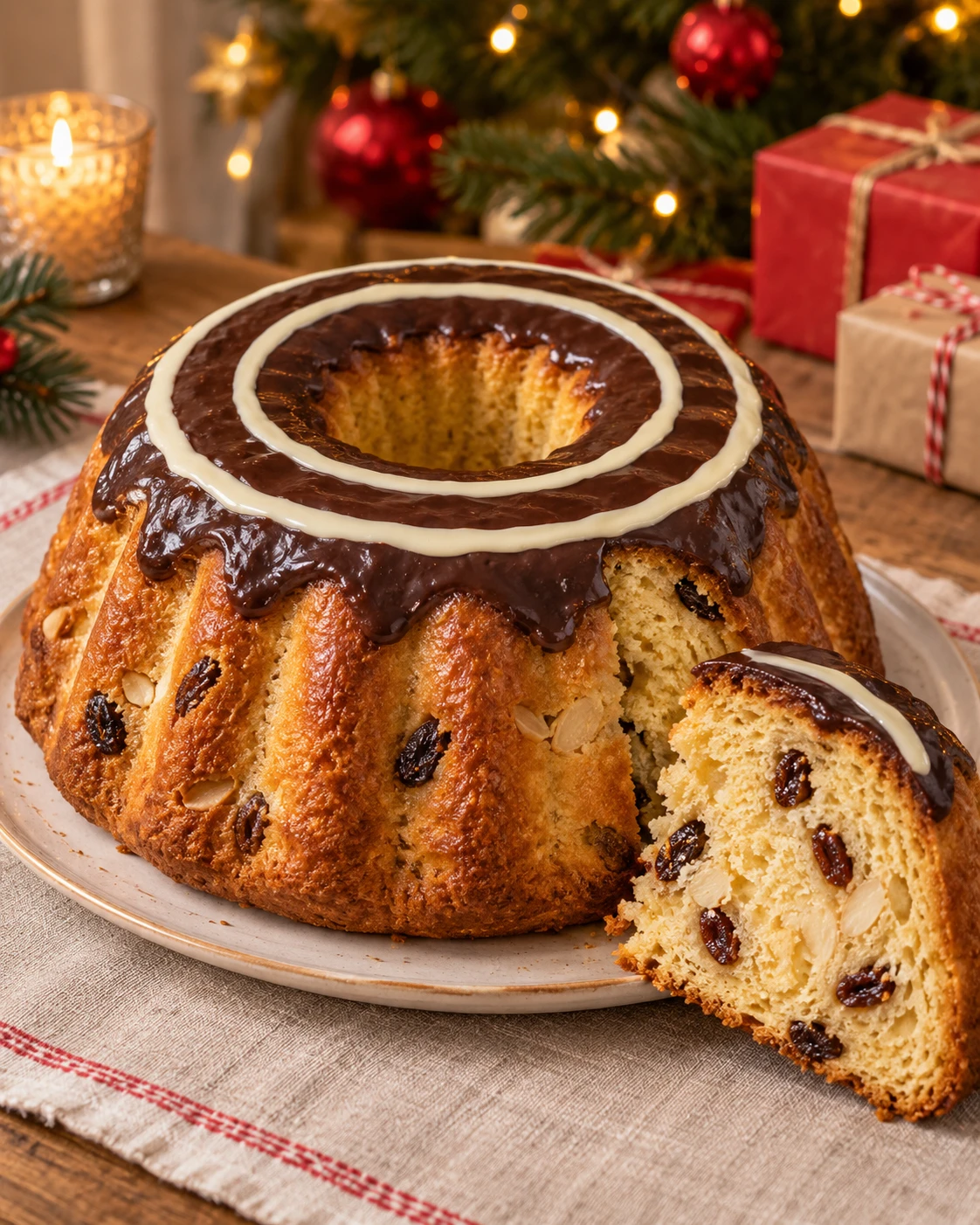
Disco Ball Panettone
Brioche / orange / raisins / white chocolate
The party is divided into quarters.
Kitchen Mode and Timer
Keep the recipe at hand during preparation.
Enables JavaScript to use the kitchen tools.
Visual Timer: Keeps this page open. It does not sound an alarm. The cooking remains to be monitored.
That's all you need!
Equip me with a pack.If you miss something, choose your ingredients from Monoprix and your utensils on Amazon. Adjust the quantities to your guests, then uncheck what you already have.
Choose the number of guests and uncheck what you already have at home.
This sheet indicates a yield in parts or in weight. Specify your basis for calculating the races.
Your selection contains only the checked items. Check products and availability at Monoprix for ingredients, on Amazon for utensils.
Amazon Affiliate Links. As an Amazon Associate, I earn from qualifying purchases.
Your choices are memorized on this device.
It's up to you.
16 detailed steps, from preparation to service.
Prepare the ingredients of the brioche
Weighing 450 g of flour, 8 g of dry yeast, 100 g of sugar and 5 g of salt. Cut the 140 g of soft butter from the dough into cubes and keep the 10 g of butter from the top apart. Prepare 120 g of raisins and 100 g of candied orange peels cut into small cubes; any orange or chocolate ingredients in the decor remain separate.
Tie milk, break eggs and zester
Heat the 150 ml of milk to about 30 °C, without boiling it. Break the three average eggs one by one in a small bowl, remove any shell and beat them 20 seconds with a fork. Wash and dry the untreated orange, then take only its orange skin with a fine grater, without the bitter white part. Keep the zest with the vanilla teaspoon.
Bringing the ingredients together in the robot
Put the flour in the tank equipped with the hook. Add yeast, sugar, salt, beaten eggs and milk; if the manufacturer asks to rehydrate the yeast, do it first with a portion of the milk already measured. Mix 2 minutes at low speed to moisten the flour, then stop the robot and scrape the walls with the spatula.
Developing the dough before butter
Kneaded another 8 minutes at slow to medium speed, or about 10 minutes since the beginning of the mixture. The dough should begin to stretch and gather around the hook, even if it remains sticky. Do not add flour to dry it; an important addition would make the brioche heavy. If the tank heats up, stop for a few minutes before continuing.
Stir in butter three times
Add about a third of the 140 g of soft butter and lets the hook work until there are no more pieces left. Repeat with the other two thirds, then continue kneading 10 to 15 minutes in total for this phase. The dough becomes smooth and elastic: a small portion can stretch between the fingers into a flexible membrane before tearing. Scrape the edges if butter sticks to it.
Distribute fruits and fragrances
Add the 120 g of raisins, the 100 g of candied orange dice, the zest taken and the teaspoon of vanilla. Mix 1 minute at a small speed, then end with the spatula if the fruits remain grouped at the bottom. Gather the dough in the vat and cover it. Fruits should be spread throughout the dough, without continuing a long kneading that would crush them.
Wait for the volume doubling
Let rise for about 2 hours in a room around 24 °C, away from drafts. Locate the starting height on the tank to see that the volume has actually doubled; in a cooler room, the rise can be longer. The oven used as a resting place should be turned off and not hot, so as not to melt the butter from the dough.
Form a ball and put it in the mold
Place a 1.5 kg panettone paper mold on a cold baking sheet. Gently press down on the dough to chase away the big bubbles, then fold its edges towards the center with a spatula and clean hands. Turn the ball over to place the smooth face above and place it in the center of the mold. The folds must be underneath, without stretching the dough until it tears.
Let it rise a second time
Cover the mold with a light cloth without squeezing and leaves to rise 1 hour 30 minutes to 2 hours, until the dough arrives at about 2 cm from the edge. Above all, check the height and swelling; do not wait for it to overflow. Preheat the oven to 170°C in conventional oven setting (no fan) for the last 20 minutes. Place the wire rack low enough for the dome to have room to rise.
Grinding and depositing butter from the top
Remove the laundry and draw a small shallow cross in the center of the top with a sharp knife, without pressing to deflate the brioche. Put the 10 g of butter reserved for the crossing of this cross. Bake immediately on its baking tray for 45 to 55 minutes. Do not open the oven for the first 25 minutes to allow the dome to expand.
Check the cooking in the center
After 25 minutes, if the top is already golden, protect it with a sheet of baking paper without contact with the heating elements. From 45 minutes, insert a probe in the center of the brioche: aim about 93 ° C, avoiding a large piece of fruit. If this temperature is not reached, extend in periods of 5 minutes. The simple staining of the dome is not enough to check the crumb.
Cool before touching the decor
Take out the plate with oven gloves and place the panettone still in its mold on a wire rack. Let it cool for at least 2 hours and wait longer if the center remains warm; do not cut it hot. This yeast version gives a brioche, different from a sourdough panettone. The chocolate of the decor will only be added on a cold and dry surface.
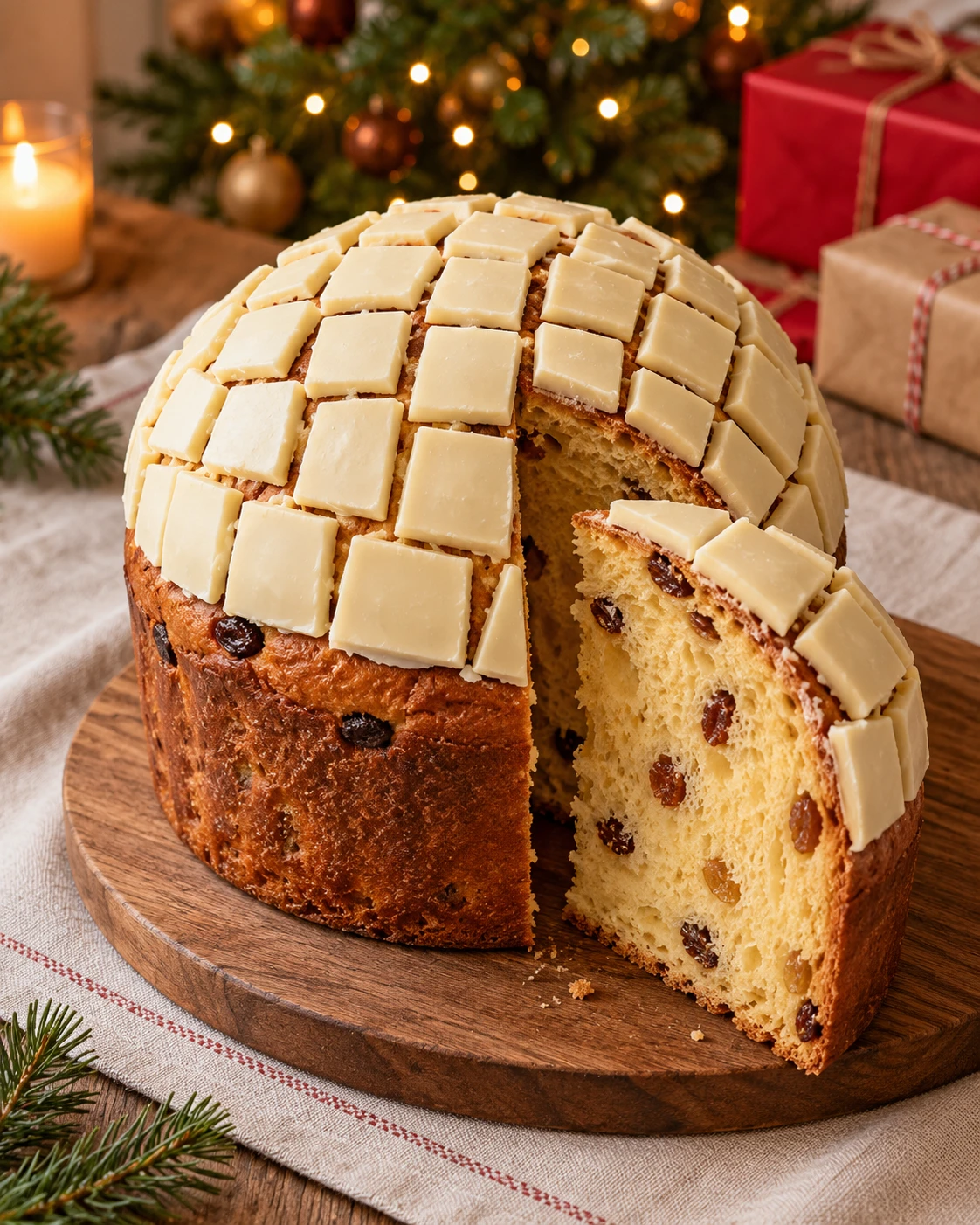
Make a fine plate of white chocolate
Weigh the 160 g of white chocolate and divide them into two portions: 120 g for squares and 40 g for sticking them. Chop 120 g of white chocolate and put them in a small, perfectly dry bowl. Set the bowl over a saucepan containing a little hot water, keeping the bowl clear of the water. Melt over a very low heat, stirring. Remove the bowl when the chocolate has almost melted and stir off the heat until smooth. Wipe the bottom of the bowl; no drop of water should fall into the chocolate. Spread this portion on a sheet of baking paper placed on a baking tray, in a layer of about 2 mm. Keep the remaining 40 g of white chocolate for gluing, without mixing with the plate. Do not spread the preparation too thinly: the squares must be able to be lifted without being reduced to fragments.
Mark and then separate the squares
When the chocolate becomes matte while remaining flexible, trace a wire rack of 2 cm squares with a knife, going all the way to the paper. Let it harden completely for 20 to 30 minutes, then gently fold the paper along the lines to separate the squares. Keep irregular fragments and extra squares to serve next to; it is not necessary to stick them all on the cake.
Paste the squares on the cold dome
Chop 40 g of white chocolate and put them in a small, perfectly dry bowl. Set the bowl over a saucepan containing a little hot water, keeping the bowl clear of the water. Melt over a very low heat, stirring. Remove the bowl when the chocolate has almost melted and stir off the heat until smooth. Wipe the bottom of the bowl; no drop of water should fall into the chocolate. Remove the paper from the panettone only if you want to present it without a mold, then place it on its plate. Put a small drop of melted chocolate on the back of a square and press it for a few seconds on the dome. Continue in spaced rows, keeping small gaps of brioche visible; the flanks remain naked.
Allow to be taken and served
Let the decor take 30 minutes without moving the panettone. The squares should fit the dome and remain fully supported by the brioche, with no piece in balance on the edge. Cut the parts with a bread knife, accepting that a few squares come loose to be shared. Serve the remaining squares and chocolate drops in a small cup, with the slices.
Conservation. 3 days well packed at cool room temperature.
Namely. Recipe proposal: follow the quantities and texture marks of the card. Indicative times. The rendering depends on the ingredients and materials used. The objects of the photographic decoration remain out of the dish.
Baking tips for this recipe
- Weigh the yeast and uses the type indicated in the recipe: yeast and yeast are not interchangeable.
- Observe the increase in volume during shoots. A cool room can lengthen the times indicated.
- Respect the dimensions of the mold and the amount of dough: a brioche too tight or too full does not cook in the same way.
Substitutions and variations
Blond or brown raisins can be used at the same weight; retains the soaking step when it is planned.
To vary a zest, choose another citrus fruit washed and intended for this use, keeping the same amount. Does not automatically replace juice, whose acidity can change the preparation.
More treats for your Christmas table
Recipes that share ingredients or the same preparation family.