Chestnut-Shaped Chocolate Truffles
Dark chocolate / almond
Chestnuts that melt without cooking with fire.
Kitchen Mode and Timer
Keep the recipe at hand during preparation.
Enables JavaScript to use the kitchen tools.
Visual Timer: Keeps this page open. It does not sound an alarm. The cooking remains to be monitored.
That's all you need!
Equip me with a pack.If you miss something, choose your ingredients from Monoprix and your utensils on Amazon. Adjust the quantities to your guests, then uncheck what you already have.
Choose the number of guests and uncheck what you already have at home.
This sheet indicates a yield in parts or in weight. Specify your basis for calculating the races.
Your selection contains only the checked items. Check products and availability at Monoprix for ingredients, on Amazon for utensils.
Amazon Affiliate Links. As an Amazon Associate, I earn from qualifying purchases.
Your choices are memorized on this device.
It's up to you.
14 detailed steps, from preparation to service.
Preparing the ganache and reserving the decor
Weigh 250 g of 60% dark chocolate, then finely chop it with a knife on a dry board. Put the pieces in a heat-resistant bowl. Measure 150 ml of whipping cream in a saucepan and cuts the 30 g of butter into small dice; keeps the finishing ingredients separate so as not to mix them with ganache.
Gently heat the cream
Place the pan on medium heat and watch it without moving away. As soon as small bubbles appear on the edges and a little steam is released, remove it from the heat; do not let the cream boil for a long time, which would evaporate some of the liquid. Stir once with a clean spatula.
Pour the cream in three additions
Pour about a third of the hot cream over the chopped chocolate and wait 30 seconds. Stir with the spatula in small circles in the center: the mixture may at first appear thick and irregular. Add the second third, mixes in the same way, then pours the last third; gradually widens the circles to the edges of the bowl.
Get a smooth ganache
Scrape the bottom and the walls: there must no longer remain a piece of chocolate. If some chips persist, place the bowl for a few seconds over a pot of simmering water, without contact with water, and then stir off the heat. Stop as soon as the ganache is smooth and shiny; avoid the whisk, which would incorporate unnecessary bubbles.
Add the butter to the warm ganache
Let the ganache cool for a few minutes, stirring occasionally; it should be below 40°C. Add the 30 g of butter into small cubes and slowly mix with the spatula until the pieces disappear. The preparation must be flexible and homogeneous, without a separate sheet of butter on the top.
Refrigerate in a shallow dish
Pour the ganache into a clean dish, on a layer of about 2 cm, and scrape the bowl well. Cover the dish and place it in the refrigerator for 3 hours. It is ready when you can take a portion that keeps its shape; if it spreads out immediately, put it back in the refrigerator before starting the shaping.
Weigh twenty-four regular servings
Weigh the cold ganache recovered from the dish and divide its weight by 24: you will get about 18 g per truffle. Take the portions with two small spoons on a baking sheet covered with baking paper. Keep the dish in the refrigerator while you form the first pieces if the room is hot; all portions must remain firm enough to be handled.
Give truffles a brown shape
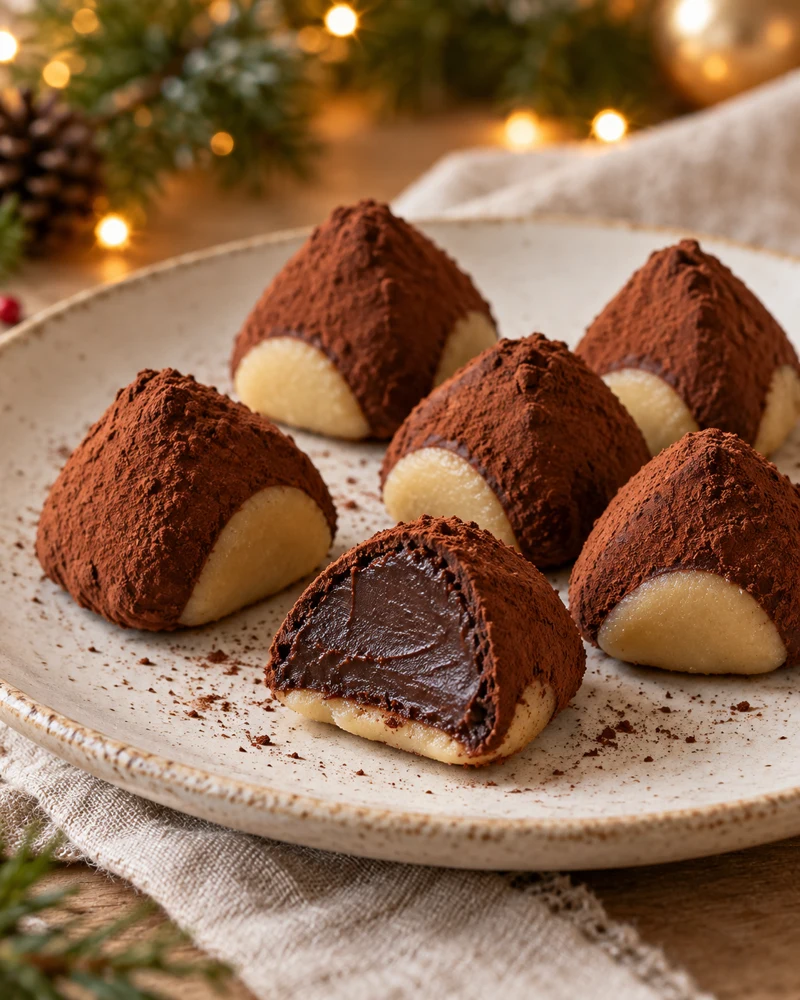
With clean, dry and fresh hands, quickly rolls a portion into a ball. Very slightly pinch the top between the thumb and forefinger to form a rounded tip, then flatten the base a little. Aim for a short, slightly triangular shape with no sharp corners. Place each chestnut on the tray before shaping the next.
Prepare the cocoa coating
Pour the 40 g of unsweetened cocoa into a hollow plate. Place a truffle in it and roll it up gently with two small spoons to cover all sides. Lift it up, gently pat the spoon against the edge of the plate to drop the excess, then put it back on the baking paper.
Strengthen chestnuts before decorating them
Place the plate in the refrigerator for 20 minutes, without stacking the truffles. Take this time to clean and dry the worktop that will serve the marzipan: traces of cocoa would stain it immediately. Reserve the remaining cocoa in a small box for another use, since it does not need to adhere entirely to truffles.
Divide the marzipan
Weigh the 70 g of plain marzipan and cut into 24 pieces as regular as possible, about 3 g each. Roll each piece between the fingers into a small ball, then flatten it between two small pieces of baking paper. Shapes a thin oval about 2 cm long, with fingers rather than adding sugar or flour.
Preparing an area of adhesion
Get four truffles out of the fridge at once. On the bottom of their front, gently remove the excess cocoa with the tip of a clean finger or the back of a small spoon; it only takes one place the size of the oval. This slightly less powdery area helps the marzipan to hold without glue or new chocolate.
Put the clear pellets
Place an oval of marzipan on the prepared area, leaving the point of the chestnut clear. Gently press from the center to the edges so that it follows the curve, without pushing the ganache. Repeat for all 24 truffles, chilling them again if they soften. Keep the pale patch visible and the rest of each chestnut brown.
Allow to be taken and served
Store the chestnuts in a single layer in a refrigerator box. Take them out 10 minutes before serving, then open one with a knife to show the melting ganache under the cocoa. There is no hard shell to break: the visual contrast comes only from the chocolate shape and the small almond lozenge.
Conservation. 5 days in the refrigerator in a closed box.
Namely. Recipe proposal: follow the quantities and texture marks of the card. Indicative times. The rendering depends on the ingredients and materials used. The objects of the photographic decoration remain out of the dish.
Baking tips for this recipe
- Chop the chocolate into regular pieces to facilitate its melting on contact with the cream.
- Mix in the center and gradually widen the gesture to obtain a smooth ganache, without unnecessarily incorporating air.
- Respect the indicated rest and temperature of use: a warm, soft or cold ganache does not work in the same way.
Substitutions and variations
To replace a main ingredient, choose another sheet designed with the one you want to use. Changing the proportions of fat, sugar or liquid can change the hold of the dessert.
Keep the type of chocolate provided for the structure or ganache. Switching from dark chocolate to white chocolate changes the balance: the quantities do not transpose directly.
More treats for your Christmas table
Recipes that share ingredients or the same preparation family.