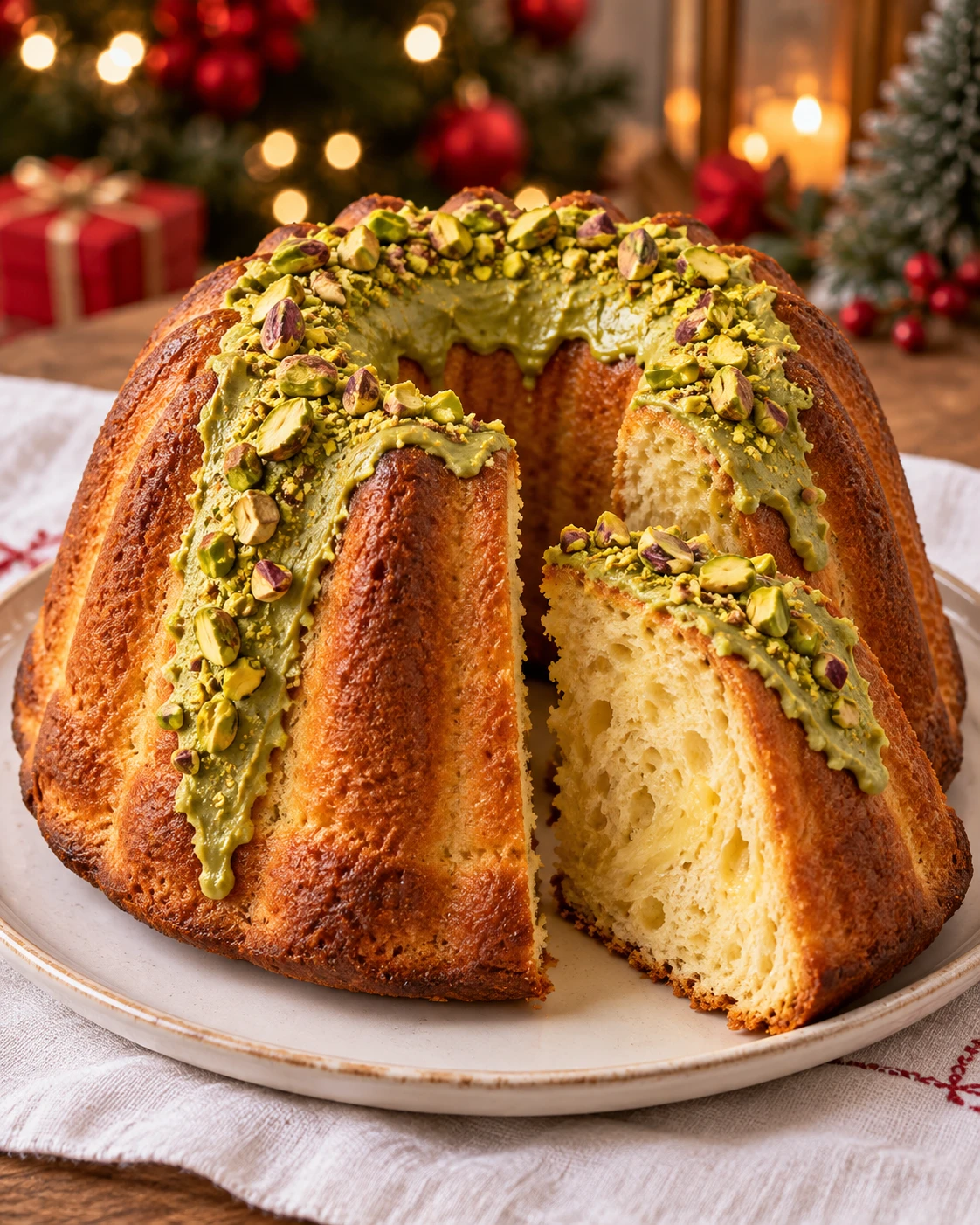
Pistachio Crater Kouglof
Brioche / grape / pistachio
Gently pluck a bite from the edge of the crater.
Kitchen Mode and Timer
Keep the recipe at hand during preparation.
Enables JavaScript to use the kitchen tools.
Visual Timer: Keeps this page open. It does not sound an alarm. The cooking remains to be monitored.
That's all you need!
Equip me with a pack.If you miss something, choose your ingredients from Monoprix and your utensils on Amazon. Adjust the quantities to your guests, then uncheck what you already have.
Choose the number of guests and uncheck what you already have at home.
This sheet indicates a yield in parts or in weight. Specify your basis for calculating the races.
Your selection contains only the checked items. Check products and availability at Monoprix for ingredients, on Amazon for utensils.
Amazon Affiliate Links. As an Amazon Associate, I earn from qualifying purchases.
Your choices are memorized on this device.
It's up to you.
16 detailed steps, from preparation to service.
Prepare raisins, butter and milk
Put the 100 g of raisins in a bowl, cover them with warm water and let them swell for 20 minutes. Meanwhile, take out the 120 g of dough butter and dice them; keep the 20 g for the mold aside. Heat the 120 ml of milk around 30 ° C: it should be barely hot, never hot.
Drain the fruit and prepare the eggs
Pour the raisins into a strainer, let them drain and spread them on a clean cloth or paper. Stamp them carefully so that they do not add their water to the dough. Break the 2 eggs in a small bowl, remove any shells and beat them a few seconds with a fork.
Bringing together the ingredients of the dough
Pour the 350 g of flour into the vat of the robot with its hook, then add the 7 g of dry yeast, the 70 g of sugar and the 4 g of salt by distributing them in the flour. Pour warm milk and beaten eggs. If the package of yeast requires a preliminary rehydration, do it with part of the 120 ml of milk already measured, without adding liquid.
Knead before adding butter
Rotate the robot at low speed for 8 minutes, stopping it once to scrape off the walls if necessary. The dough must gather around the hook and become more regular. By hand, work in a large bowl by stretching and folding the dough for about 12 minutes; it can remain sticky, do not add flour to dry it.
Stir in 120 g of butter gradually
Add the dice of soft butter in three portions, letting the dough absorb each portion before the next. Knead again about 8 minutes with the robot, or 10 to 15 minutes by hand by folding the dough on itself. It becomes flexible and elastic; if it heats up and liquefies, give it 10 minutes in the refrigerator before taking it again.
Spread the raisins and let rise
Add the well-dried raisins and mix at low speed for 1 minute, just to distribute them. Gather the dough at the bottom of the tank with a spatula, cover it and leave it in a room around 24 ° C, away from drafts. Counts about 1 hour 30 minutes, but waits especially for it to have doubled in volume; a cooler room slows the rise.
Carefully butter the mold
With the reserved 20 g of butter and a brush, covers the inside of a 22 cm kouglof mold, including the grooves and the central fireplace. Spread the 20 whole almonds at the bottom, placing one in each groove and the remaining ones between them if the mold has less than twenty. They need to touch the butter to stay in place.
Drop the dough and form the crown
Gently press the dough with your hand to chase away the biggest piping bag of gas. Gather it into a ball and then pierce its center with your fingers, widening this hole to pass around the mold chimney. Place the crown in the mold and spread the thickness with the spatula, without pulling to the point of tearing the dough.
Leave for the second rise
Cover the mold without tightening and lets the dough swell about 1 hour, until it reaches three-quarters of its height. Twenty minutes before the estimated end of this rise, preheat the oven to 175 °C, conventional oven setting (no fan). Do not place the mold on a radiator or in a hot oven to save time: the butter would melt in the dough.
Cook and then check the heart
Bake in the bottom half of the oven for 35 to 40 minutes. From 35 minutes, plant a skewer in the thickest part, without touching the mold: it must come out without raw dough. If the top becomes too brown before the heart is cooked, cover it with a piece of baking paper held by the edges of the mold.
Unmould and then cool completely
Let the kouglof rest for 10 minutes in its pan at the outlet of the oven. Lay a wire rack over it, flip the whole with oven gloves and gently lift the mold. Allow to cool for about 1 hour 30 minutes; before the decor, the underside and troughs should be cold to the touch.
Sprinkle without covering the future decor
Place the kouglof on its presentation plate. Put the 20 g of icing sugar in a small colander and pat on top to create a regular veil, leaving little powder on the top where the decor will be glued. Keep the dish accessible and prepare the following garnishes: they should not encounter any crumbs that are still hot.
Prepare the pistachio paste and white chocolate
Chop the 80 g of white chocolate with a knife and put them in a perfectly dry bowl. Pour 2 cm of water into a small saucepan, heat to a gentle simmer and then lower the heat. Set the bowl over the pan without touching the water and stir with a spatula. Remove while a few small pieces remain and stir off the heat until melted. Wipe the bottom of the bowl and do not pour any water into the chocolate. In another bowl, stir the 50 g of pure pistachio paste to reincorporate its oil if it has separated. Pour it into the melted white chocolate and mix with the spatula until a homogeneous color is obtained, then let cool for a few minutes to form a thick paste that fits on the spoon.
Opening the crown with a small part
With a serrated knife, cut a small part of the kouglof completely cold, like a piece of ordinary cake. Remove it with a spatula and place it next to it on the same flat, visible crumb. Do not dig the crown and do not fill the chimney: the cake must remain stable on its base.
Spread the decor on the planned areas
Place the pistachio paste by spoon around the top edge of the central hole, then stretch it on only two grooves with the back of the spoon. Divide the quantity into a thick layer but supported by the crumb, with irregular traces; the other grooves remain uncovered. If the dough flows, wait a few more minutes in the bowl before continuing.
Press on the pistachios and leave to set
Spread the 40 g of chopped pistachios only over the still soft areas of pistachio paste, pressing lightly with your fingertips. Pick up the chips that fell on the plate and put them back on the decor or on the small part removed. Let it firm for 20 to 30 minutes in a cool room before cutting off the other parts; keep the kouglof under the bell for up to 2 days.
Conservation. 2 days under bell; possible freezing in slices.
Namely. Recipe proposal: follow the quantities and texture marks of the card. Indicative times. The rendering depends on the ingredients and materials used. The objects of the photographic decoration remain out of the dish.
Baking tips for this recipe
- Weigh the yeast and uses the type indicated in the recipe: yeast and yeast are not interchangeable.
- Observe the increase in volume during shoots. A cool room can lengthen the times indicated.
- Respect the dimensions of the mold and the amount of dough: a brioche too tight or too full does not cook in the same way.
Substitutions and variations
Blond or brown raisins can be used at the same weight; retains the soaking step when it is planned.
Keep the type of chocolate provided for the structure or ganache. Switching from dark chocolate to white chocolate changes the balance: the quantities do not transpose directly.
More treats for your Christmas table
Recipes that share ingredients or the same preparation family.