Chocolate Christmas Spritz
Poached biscuits
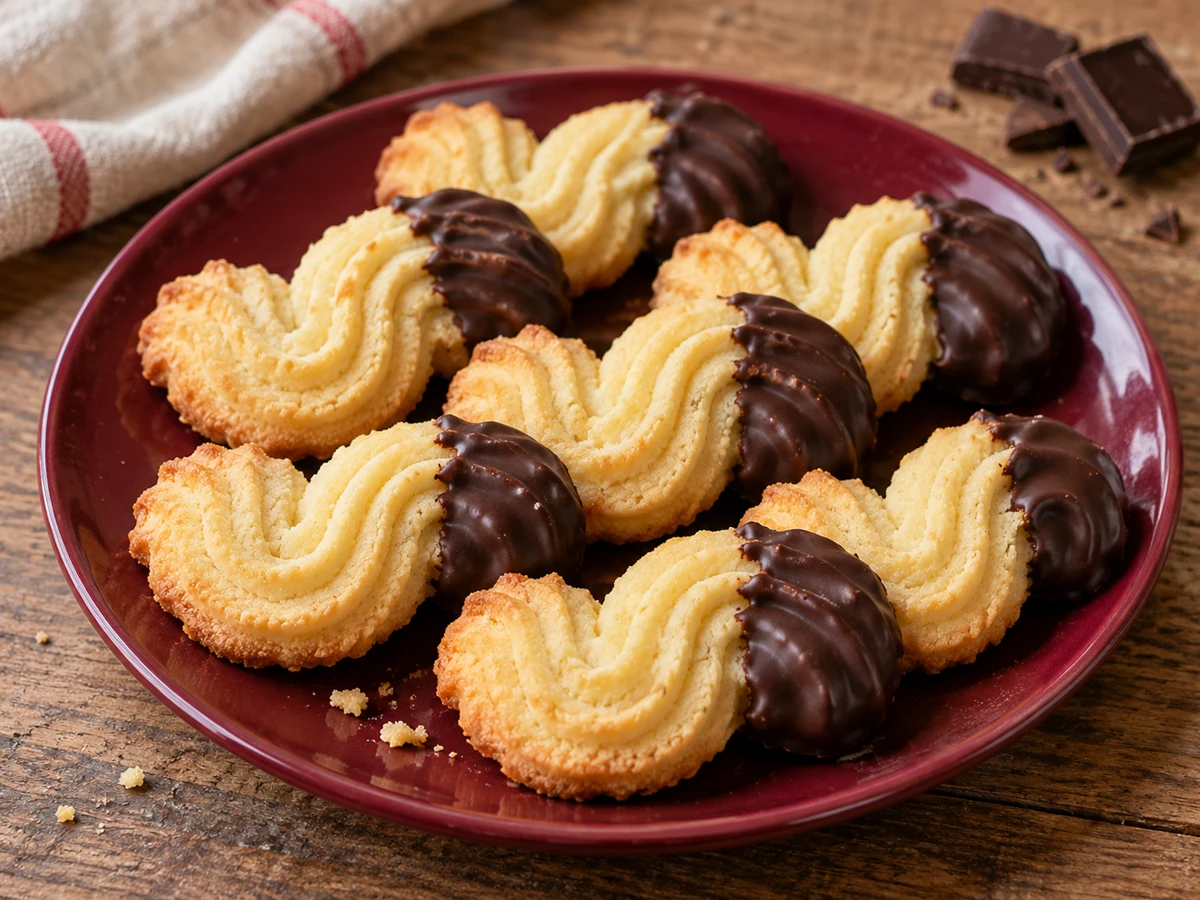
Fried W poached biscuits, one end of which is soaked in chocolate.
Kitchen Mode and Timer
Keep the recipe at hand during preparation.
Enables JavaScript to use the kitchen tools.
Visual Timer: Keeps this page open. It does not sound an alarm. The cooking remains to be monitored.
That's all you need!
Equip me with a pack.If you miss something, choose your ingredients from Monoprix and your utensils on Amazon. Adjust the quantities to your guests, then uncheck what you already have.
Choose the number of guests and uncheck what you already have at home.
This sheet indicates a yield in parts or in weight. Specify your basis for calculating the races.
Your selection contains only the checked items. Check products and availability at Monoprix for ingredients, on Amazon for utensils.
Amazon Affiliate Links. As an Amazon Associate, I earn from qualifying purchases.
Your choices are memorized on this device.
It's up to you.
12 detailed steps, from preparation to service.
Soften the butter without melting it
Take out the 200 g of butter in advance, cut them into small cubes and let them soften at room temperature. They should squash easily when pressed with a spatula, but no part should be liquid. Weigh 80 g of icing sugar, 230 g of flour and 100 g of dark chocolate in separate containers. Also prepare the vanilla, salt and egg which you will use only the white.
Prepare the egg white and oven
Break the egg over a small bowl and gently separate the white from the yolk, without dropping any shell. Weigh 30 g of white and keeps the yolk and any surplus for another preparation. Turn the oven on at 170 °C, conventional oven setting (no fan), and covers two baking paper baking tray. Prepare a solid piping bag equipped with a 12 mm fluted sleeve; the dough is firm and a small sleeve would be difficult to use.
Cream butter with sugar
Put the very soft butter in a bowl and tweez it for about 1 minute to make it smooth. Add the 80 g of icing sugar, first by mixing gently to avoid a cloud of sugar, then whips another 1 to 2 minutes. Scratching the walls with a spatula. You need to get a smooth, even cream, without small pieces of butter.
Add white, vanilla and salt
Pour the 30 g of egg white in half into the butter, whisking gently after each addition. Add 1 teaspoon of vanilla and 1 pinch of salt. Mixing just enough to bring it all together: do not turn white into snow. If the mixture appears slightly irregular, scrape the bowl and mix again before adding the flour.
Fold in flour into the spatula
Add the 230 g of flour twice. With each addition, pass the spatula to the bottom of the bowl and fold the dough on itself to make disappear the areas of dry flour. Stop as soon as the dough is even. It must remain very flexible but hold on the spatula; working it for a long time would make the cookies harder.
Fill the piping bag without overloading it
Fold the top of your piping bag on your hand or on the edge of a high glass. Place about half of the dough inside with a spatula, then flap the pouch and push the dough towards the piping tip by chasing away the large air pockets. Twist the top to close. Keep the other half in the bowl covered: an overfilled piping bag is more difficult to squeeze.
Regular W piping bag
Keep the piping tip close to the plate, without crushing it against the paper. Press regularly with the hand that closes the piping bag and guides the piping tip with the other hand to draw W of about 5 cm. Stop pressing before lifting the piping tip to avoid a long tip. Shapes about 24 cookies in total, spaced 3 cm apart; the grooves should remain visible.
Adjust the flexibility before continuing
If you have to force very hard to remove the dough, stop and leave the bag at room temperature for 5 minutes before trying again. Do not add water or milk: this would alter the dough and cause the grooves to lose. If the W spreads out immediately, put the plate in the refrigerator for 10 minutes. Then fill the piping bag with the rest of the dough and finish the second plate.
Cook and then cool
Bake one baking tray at a time in the middle of the oven, for 12 to 14 minutes at 170 °C. Take it out when the edges and reliefs begin to brown, with a still clear center. Wait 5 minutes before moving the cookies to the spatula on a wire rack. Let them cool completely, about 25 minutes, and cook the second plate in the same way.
Melt 100 g of chocolate
Chop the dark chocolate and put it in a small, heat-resistant bowl, perfectly dry. Place this bowl on top of a pan containing a bottom of simmering water, without contact between the water and the bowl. Stir with a spatula until the chocolate is almost melted, then remove the bowl and finish mixing off the heat. Wipe the bottom of the bowl to prevent a drop of water from falling on the cookies.
Dip one end of each cookie
Take a completely cold spritz by its end and dip the other side in melted chocolate, about a third of its length. Lift it up, let the excess run for a few seconds in the bowl, then place it on a new sheet of baking paper. Repeat for all cookies. The remaining chocolate in the bowl is a surplus of soaking: spread it in small pellets to harden next to.
Wait until the chocolate is dry to the touch
Leave cookies flat for 30 to 45 minutes in a cool room. Check one end: the chocolate should be firm and not transfer to the finger when you touch it. Extends the socket if necessary, especially in a warm kitchen. Only then store the spritz in a box, separating the layers with baking paper.
Conservation. 5 days in hermetic box in the cool and dry.
Namely. Recipe proposal with quantities and step by step. Indicative times. The rendering depends on the ingredients and materials used. The objects of the photographic decoration remain out of the dish.
Baking tips for this recipe
- Work the dough just enough to combine the ingredients after adding flour; avoid prolonged kneading.
- Respect the temperature of the butter and the indicated rest. If a cutting paste becomes sticky, cool it before shaping.
- Keep a regular thickness between pieces of the same batch and monitors the edges at the end of cooking. Let cool before garnishing.
Substitutions and variations
To replace a main ingredient, choose another sheet designed with the one you want to use. Changing the proportions of fat, sugar or liquid can change the hold of the dessert.
Keep the type of chocolate provided for the structure or ganache. Switching from dark chocolate to white chocolate changes the balance: the quantities do not transpose directly.
More treats for your Christmas table
Recipes that share ingredients or the same preparation family.