Christmas Raisin Kouglof
Moulded Brioches
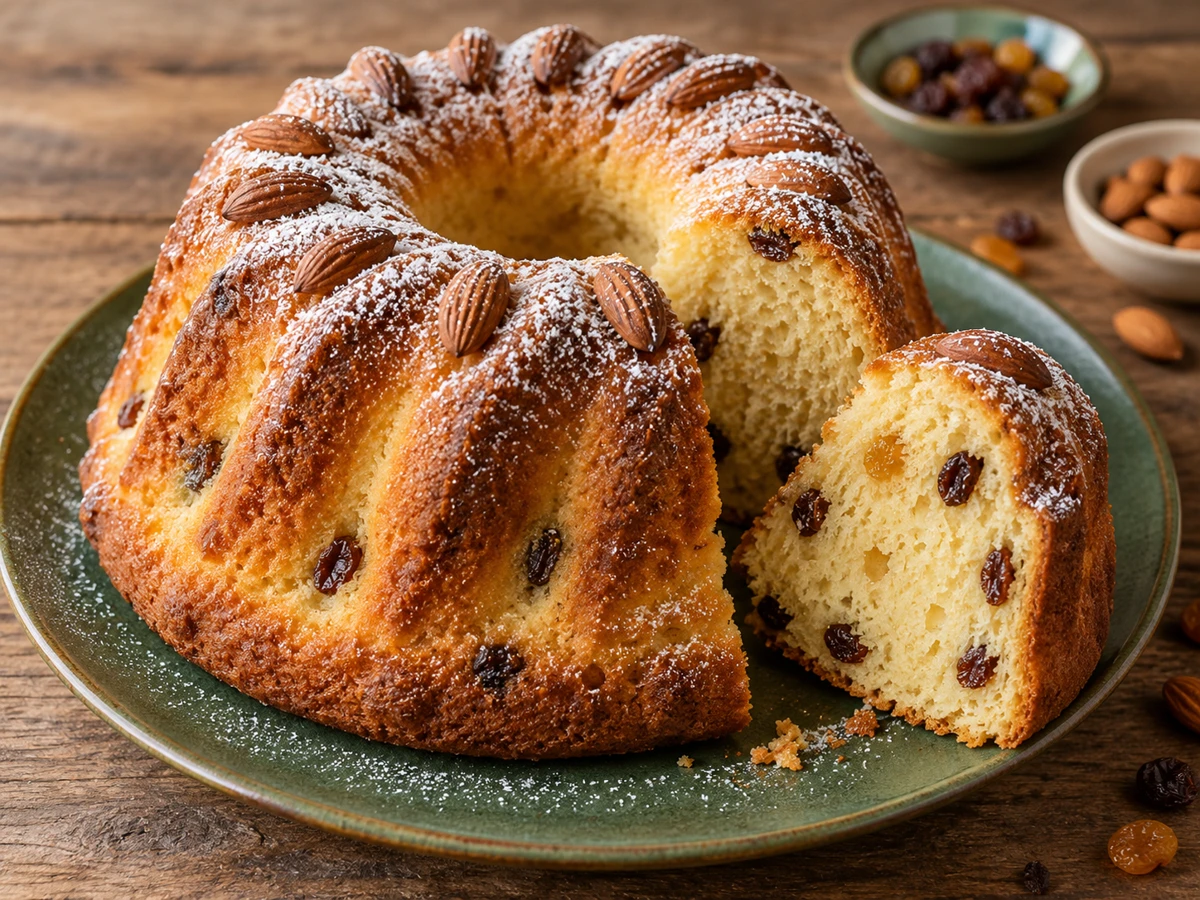
A fluted brioche in crown, with almonds lodged on the top.
Kitchen Mode and Timer
Keep the recipe at hand during preparation.
Enables JavaScript to use the kitchen tools.
Visual Timer: Keeps this page open. It does not sound an alarm. The cooking remains to be monitored.
That's all you need!
Equip me with a pack.If you miss something, choose your ingredients from Monoprix and your utensils on Amazon. Adjust the quantities to your guests, then uncheck what you already have.
Choose the number of guests and uncheck what you already have at home.
This sheet indicates a yield in parts or in weight. Specify your basis for calculating the races.
Your selection contains only the checked items. Check products and availability at Monoprix for ingredients, on Amazon for utensils.
Amazon Affiliate Links. As an Amazon Associate, I earn from qualifying purchases.
Your choices are memorized on this device.
It's up to you.
14 detailed steps, from preparation to service.
Inflate and then dry the raisins
Put the 100 g of raisins in a bowl and cover with warm water. Let them inflate for 20 minutes, then pour them into a colander. Spread them on a clean cloth or absorbent paper and dab them: they must be flexible but no longer bring water into the dough. Meanwhile, prepare the other ingredients.
Separate dough butter and moulds butter
Weighing 350 g of flour, 70 g of sugar, 7 g of dry yeast and 4 g of salt. Put the 120 g of soft butter for the dough in a bowl, diced. Keep aside the 20 g of butter for the mold and the 20 g of icing sugar for the finish. Prepare a robot with hook or large bowl, as well as a 22 cm kouglof mold.
Prepare milk and eggs
Gentle the 120 ml of milk to about 30 °C: it should not be hot. Break the 2 eggs in a small bowl, check for the absence of shell, then beat them briefly with a fork. Read the yeast sachet: if rehydration is indicated, do it with some of the milk already measured, without adding any additional liquid. Otherwise, add the yeast directly with the flour.
Gather the dough without the butter
Pour flour, sugar and yeast into the bowl of the robot. Add the warm milk and beaten eggs, then start mixing with the hook at a small speed. Add the 4 g of salt once the ingredients are slightly combined. Mix until the flour piping bag disappear; the dough remains sticky and the butter is not yet incorporated.
Knead to give the outfit
Let the hook rotate at slow or medium speed for about 8 minutes, stopping once to scrape the bottom of the bowl. By hand, fold the dough on itself and then push it with the base of the palm, regularly bringing it back with a spatula; plan a few minutes more. It must begin to become elastic. Do not add handfuls of flour to remove any adhesion: a brioche remains flexible.
Gradually Incorporates 120 g of butter
Add the soft butter three or four times, until each addition is almost absorbed before the next. Continue to knead about 8 minutes after the beginning of this incorporation. The dough can first tear and slide into the bowl, then it gathers. It is ready when it becomes smooth, flexible and stretchy, with only a slight sticky veil on the walls.
Add the raisins without crushing them
Add the well-drained and dried raisins to the dough. Mix at the slowest speed for 30 to 60 seconds, or folds the dough by hand until it is spread. Stop as soon as they're not together in one pile. Gather the dough at the bottom of the bowl and cover it to prevent its surface from drying.
Wait for the volume doubling
Leave the bowl in a temperate room, around 24 °C, for about 1 hour 30 minutes. Take a picture or spot the starting level to judge the swelling. The dough should almost double in volume; if the kitchen is cooler, prolong the wait. Do not place the bowl on a radiator or in a lit oven to speed up lifting.
Butter every groove of the mold
With a clean brush or fingers, spread the reserved 20 g of butter throughout the mold, including the grooves and the central chimney. Place the 20 whole almonds at the bottom: put one in each groove, then distribute any remaining ones between them. Don't leave them in a big pile. The butter must form a thin but continuous layer to facilitate demoulding.
Shape a crown around the fireplace
Gently press the dough with your fingers to evacuate the big bubbles: it is "degassing". Gather it into a ball, then make a hole in the center with your fingers and gradually widen it. Place the crown in the mold around the chimney, without tearing the dough. Equalizes the height with the fingers to avoid one side much thicker than the other.
Let it rise a second time
Cover the mold without tightening and leaves to rise about 1 hour in temperate temperature. The dough should reach about three-quarters of the height of the mold and appear swollen. Towards the end of the rise, start preheating the conventional oven to 175 °C (no fan). If the dough has hardly moved after an hour, wait longer before cooking.
Cook and control the center
Place the pan on the rack in the bottom half of the oven and cook for 35 to 40 minutes. The top must be very golden. Push a skewer into the thickest part, between the edge and the chimney: it must come out without raw dough. If necessary, extend it by 5 minutes; if the top color too much, protect it with a sheet of baking paper.
Unmolded after a short wait
Remove the mould with oven gloves and let it sit for 10 minutes on a stable surface. Protect your hands, place a wire rack over the tin, and carefully invert the tin and rack together. Lift the mold gently; if it resists, wait a few more minutes rather than pulling on the cake. Then let the kouglof cool completely on the grill, at least 1 hour 30 minutes depending on its height.
Powder only when kouglof is cold
Put the 20 g of finishing icing sugar in a small strainer. Tap above the cold kouglof to lay a regular veil over the top and grooves. If it is still lukewarm, the sugar will melt on contact. Finally put the kouglof on his plate and cut slices with a bread knife, without crushing the crumb.
Conservation. 2 days under bell; possible freezing in slices.
Namely. Recipe proposal with quantities and step by step. Indicative times. The rendering depends on the ingredients and materials used. The objects of the photographic decoration remain out of the dish.
Baking tips for this recipe
- Weigh the yeast and uses the type indicated in the recipe: yeast and yeast are not interchangeable.
- Observe the increase in volume during shoots. A cool room can lengthen the times indicated.
- Respect the dimensions of the mold and the amount of dough: a brioche too tight or too full does not cook in the same way.
Substitutions and variations
Blond or brown raisins can be used at the same weight; retains the soaking step when it is planned.
More treats for your Christmas table
Recipes that share ingredients or the same preparation family.