
THE FESTIVAL CARNET
Christmas Butter Shortbread (Butterbredele)
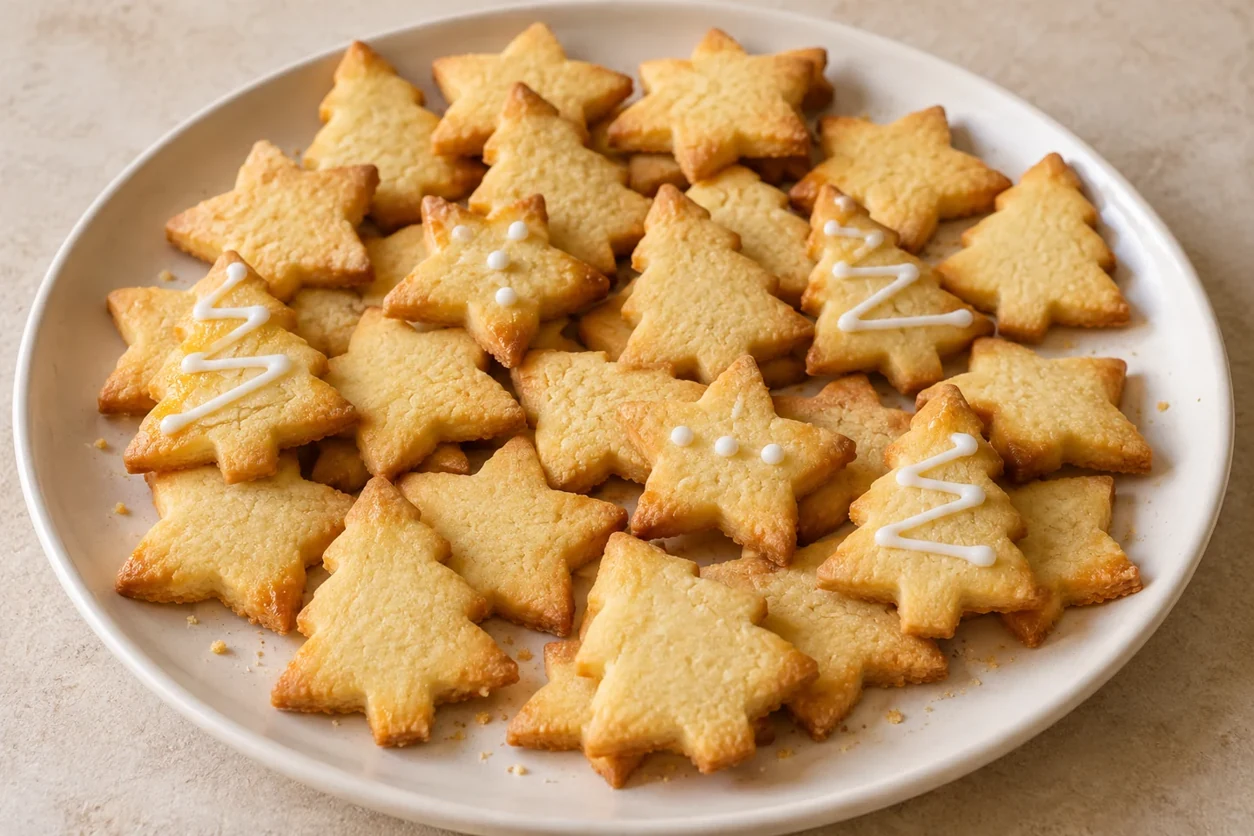
Prepare buttery Christmas shortbread inspired by Alsatian butterbredeles: a simple dough to cut, an optional gilding and a lemon-sugar icing to write a first name or trace some patterns.
Kitchen Mode and Timer
Keep the recipe at hand during preparation.
Enables JavaScript to use the kitchen tools.
Visual Timer: Keeps this page open. It does not sound an alarm. The cooking remains to be monitored.
Butterbredele is a small Alsatian Christmas cookie with butter, cut with a cookie cutter. Here, prepare a vanilla version in stars, hearts or discs. The center remains blond at the exit of the oven and becomes firmer when cooling down: there is no need to wait for the whole cookie to brown.
Choose your finish: leave your cookies natural, brown them before cooking or add a few icing strokes once they are cold. To customize them, write only an initial or a short name on a disc. You don't need fondant or sculpture.
Plan three small batches. The times below include one hour of dough rest, cooling and two hours of drying for decorated cookies. If you use them in nature, remove the icing and drying time; if the air is humid, the decor may take longer. The durations remain indicative.
That's all you need!
Equip me with a pack.If you miss something, choose your ingredients from Monoprix and your utensils on Amazon. Adjust the quantities to your guests, then uncheck what you already have.
Choose the number of guests and uncheck what you already have at home.
This sheet indicates a yield in parts or in weight. Specify your basis for calculating the races.
Your selection contains only the checked items. Check products and availability at Monoprix for ingredients, on Amazon for utensils.
Amazon Affiliate Links. As an Amazon Associate, I earn from qualifying purchases.
Your choices are memorized on this device.
The preparation step by step
Prepare and weigh the ingredients
Cut the 125 g of butter into small dice: they must be marked under the finger without being oily. Weigh the 250 g of flour in the bowl, add the baking powder and salt, then mix. Break the whole egg on a flat surface and open it above the small cup, so that you can remove any shell fragment before adding it to the dough.
Shapes a sandy texture
Add the butter cubes to the flour. Quickly rub the mixture between the tips of your fingers, then let it fall back into the bowl. Continue until small crumbs are fairly regular; large cubes of butter must no longer remain. This gesture is called sanding. Work quickly to not melt the butter with your hands.
Gather the dough without kneading it for a long time
Add 125 g of sugar, 4 g of vanilla sugar and the whole egg. Mix first with the spatula, then press the crumbs together with the hand. Stop as soon as the dough forms a homogeneous mass. If a few crumbs remain at the bottom, crush them against the dough rather than adding water. Do not try to obtain an elastic paste: prolonged work would harden the cookies.
Let it sit for an hour in the refrigerator
Divides the dough into two parts and flattens each into a disc about 2 cm thick. Pack them or place them in a closed box, then refrigerate for 1 hour. This flat shape cools more regularly than a big ball and will be easier to spread. Keep one half cool while you work the other.
Prepare the oven and spread to 4 mm
Preheat the oven to 180 °C in conventional oven setting (no fan), with an oven rack in the middle. Cover a cold baking sheet. Take out half of the dough; if it breaks immediately under the roll, wait 5 minutes. Spread it between two sheets of baking paper about 4 mm thick, turning the paper to keep a regular thickness. Add a veil of reserved flour only if the dough still sticks.
Cutting of regular shapes
Remove the top sheet, cut out stars, hearts or discs from 4 to 5 cm, then lift them with a flat spatula. Place them on the plate leaving about 2 cm between them. Gather the offcuts without mixing them for a long time and spread them out again. If the shapes become deformed when you lift them, put the spread in the refrigerator 10 minutes before continuing; then add this rest to the schedule.
Choose the gilding or a surface to decorate
For golden biscuits, break a second egg over a bowl and separate the yolk from the white by gently passing the yolk from half a shell to the other. Reserve the white in the refrigerator for another preparation. Mix the yolk with the 5 g of water, then apply a very thin layer with a brush on the chosen biscuits, without leaving a puddle at the edge. Leave without gilding those you want to freeze: their surface will remain clearer.
Cook one baking tray at a time
Bake in the middle of the oven for 10 to 12 minutes. Begins to watch for 8 minutes, especially with small stars: the tips and edge should become slightly golden, while the center remains blond. Take out the plate when this marker is reached. Prepare the next batch on a cold baking tray; a hot baking tray would soften the new cuts. Counts about three batches, up to 36 minutes of cumulative cooking.
Let the shortbread cool completely
Leave the cookies on their baking tray for 5 minutes, as they are fragile at the exit of the oven. Then gently transfer them to a wire rack. Wait at least 15 more minutes, and longer if they are still warm. A ready-to-ice cookie should no longer give off heat when you put a finger underneath it. Don’t keep them lukewarm in a box: condensation will soften their texture.
Prepare an icing thick enough to write
For the optional finish, pour 100 g of sieved icing sugar into a small bowl. Add the 10 g of filtered lemon juice, then 2 g of water and mix with the spoon. Add the rest of the water a few drops at a time only if necessary. The icing should fall slowly and leave a trace that remains visible for a few seconds. If it flows immediately like juice, gradually incorporate some of the reserved 10 g of icing sugar.
Trace simple patterns or an initial
Place one or two spoons of icing in a cornet or small piping bag, fold the top and cut an opening of about 1 mm. Try it on baking paper. Hold the tip just above the cookie, press gently and draw an initial, a short name, three points or a zigzag; stop pressing before lifting the piping bag. Limits the decor to a few fine strokes: the planned quantities are not used to fully cover all cookies. For a light flat on some shortbread, spread a little icing with the back of a small spoon.
Let dry before offering or storing
Place decorated cookies flat, without overlaying them, in a dry place at room temperature. Wait at least 2 hours, then delicately touch a line on a test cookie: it should no longer stick to the finger. If the decor is thick or the room is wet, prolong the drying, possibly until the next day. Store cookies only when the icing is dry, separating the layers with baking paper.
Conservation. Keep the shortbread completely cold and dry in an airtight box, at room temperature, away from heat and moisture. Prepare them up to a week in advance to keep a good texture and separate the layers decorated with baking paper. Check that the icing no longer sticks before closing the box. You can prepare the dough the day before: keep it well packed in the refrigerator, then let it soften a few minutes before spreading it. Avoid storing these shortbread with wet filled cookies, which could soften them.
Recipe proposal with quantities and step by step. Times vary depending on the material: follow also the markers of texture and cooking.
The benchmarks for success
Keep the same thickness
Put cookies of comparable size on the same plate. A very thin fir will cook before a large thick disc: separate the formats if you use several cookie cutters.
Preserves the forms
Refrigerate a dough that has become soft rather than adding a lot of flour. For a readable initial, choose a large disc or heart: the small branches of a star leave little room.
Dose the lemon according to your decor
Keep the icing thick to draw letters. For a few flats, take only 2 tablespoons of this icing and add 2 or 3 drops of water; do not lengthen the whole bowl. The drying of a flat takes longer than that of a fine line.
Predict the real time
Counts 60 minutes of preparation with decoration, up to 36 minutes of cumulative cooking and 200 minutes of rest, cooling and drying. These stations are conservative: some of the cooling is done during the next batch. The extra rest of too soft a paste and prolonged drying are added if necessary.
Make an accessible decor
Prefers an initial, an outline or a few points. A single white color is enough and lets see the golden cookie. Uses only food ingredients; does not stick to creative leisure glitter or inedible accessories.
Questions Before You Start
Are these Christmas shortbreads Alsatian butterbredeles?
This version takes up the principle of butterbredele: a butter paste cut with a cookie cutter, with a possible gilding. The proportions and scents vary between families. Lemon icing and the given names offered here are decorating options, not a traditional obligation.
Can I make these cookies without cookie cutters?
Use a fine-edged glass of about 5 cm and flour its edge very slightly if the paste sticks. You can also knife rectangles of 4 x 5 cm. Keep a thickness of 4 mm and monitors the edges from 8 minutes.
How to personalize the shortbread with a first name?
Choose large discs from the planned biscuits, wait for their complete cooling and use the thick icing with a very fine pocket-size opening. Try it on baking paper. For a long name, write only the initial or spread the letters over several cookies; do not add water to try to write smaller.
Can I prepare the icing without lemon?
Replace 10 g of lemon juice with 10 g of water. Then add the complementary water drip, as in the method, until a paste thick enough to keep a trace. The icing will be softer. It does not contain raw egg white.
Why do cookies spread during cooking?
The butter or paste may be too hot, the plate still lukewarm or the cuts too thin. Keep half of the dough unused in the refrigerator, work on a cold baking tray and cool the shapes for 10 minutes if they become soft before cooking.
Why are my shortbread cookies hard?
Too much dough, a lot of flour added during the display or too long cooking can harden the cookies. Press the dough only until it fits together, spread it between two sheets of baking paper and take out the shortbread as soon as their edge blondes. They grow stronger by cooling.
Can I follow this recipe at Thermomix TM5?
This sheet gives a complete manual method. For a tour at TM5, the official Cookidoo collection offers Butterbredele and spiced biscuits. Uses the ingredients and steps of the chosen guided recipe; no TM5 setting has been tested for the formula on this page. Rest in the refrigerator and cooking in the oven are still to be expected, even if the mixture in the robot is fast.
The recipes and creations cited
Find the guided recipes or creations of their author on the sites below. The sheet of this book remains an independent house proposal.
Baking tips for this recipe
- Work the dough just enough to combine the ingredients after adding flour; avoid prolonged kneading.
- Respect the temperature of the butter and the indicated rest. If a cutting paste becomes sticky, cool it before shaping.
- Keep a regular thickness between pieces of the same batch and monitors the edges at the end of cooking. Let cool before garnishing.
Substitutions and variations
To replace a main ingredient, choose another sheet designed with the one you want to use. Changing the proportions of fat, sugar or liquid can change the hold of the dessert.
More treats for your Christmas table
Recipes that share ingredients or the same preparation family.