
THE FESTIVAL CARNET
Tall Savoury Brioche for an Aperitif
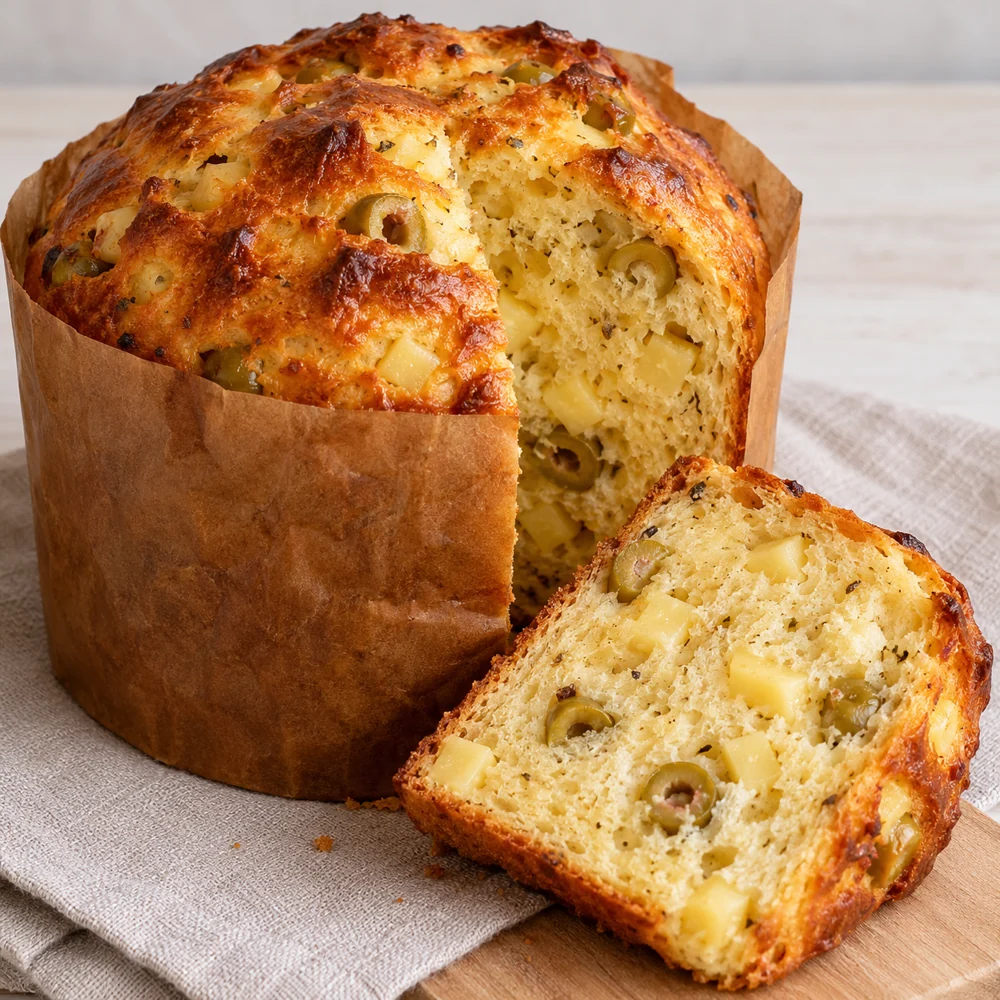
A salted brioche in high paper mold, topped with Comté cheese, green olives and dried thyme, to be sliced for the aperitif after complete cooling.
Kitchen Mode and Timer
Keep the recipe at hand during preparation.
Enables JavaScript to use the kitchen tools.
Visual Timer: Keeps this page open. It does not sound an alarm. The cooking remains to be monitored.
A salted brioche in high paper mold, topped with Comté cheese, green olives and dried thyme, to be sliced for the aperitif after complete cooling. This version is designed for a home kitchen, with weighed quantities and visual cues. Prepare the ingredients before starting and reserve the indicated cooling time: it is part of the recipe.
Read the whole steps before working on the dough. The durations remain indicative; a raised dough must actually swell, a cookie must cool before being handled and a wet filling requires a cool storage.
That's all you need!
Equip me with a pack.If you miss something, choose your ingredients from Monoprix and your utensils on Amazon. Adjust the quantities to your guests, then uncheck what you already have.
Choose the number of guests and uncheck what you already have at home.
This sheet indicates a yield in parts or in weight. Specify your basis for calculating the races.
Your selection contains only the checked items. Check products and availability at Monoprix for ingredients, on Amazon for utensils.
Amazon Affiliate Links. As an Amazon Associate, I earn from qualifying purchases.
Your choices are memorized on this device.
The preparation step by step
Prepare equipment and reserves
Weigh 400 g of flour, 15 g of sugar, 7 g of yeast and 5 g of salt in separate bowls. Cut the 70 g of soft butter into cubes. Prepare the specified baking tray or mold with baking paper; shaping will be easier if everything is already at hand.
Prepare eggs and milk
Break the 2 eggs of dough one by one into a bowl, check the shells and beat them with a fork. Keep the whole gilding egg apart. Heat the 140 ml of milk to about 30 °C, without making it hot.
Gathering the ingredients of paste
Mix flour, sugar and yeast in a bowl or in the bowl with the hook. If your yeast needs to be rehydrated, use some of the milk already measured, according to its bag. Add the beaten eggs and milk, then salt. Mix until all the flour is moistened.
Gives elasticity to the dough
Kneaded for 8 minutes at a slow speed, or about 12 minutes by hand by stretching and folding the dough. It remains slightly sticky. Scrape the edges when stopped and avoid throwing extra flour: it would make the brioche dry.
Fold in butter by small additions
Add 70 g of butter in three or four times. Wait for the first addition to be absorbed before the next. Continue for 8 to 10 minutes until you get a soft paste that stretches without breaking immediately. If it heats up or becomes oily, take a 10-minute break in the cool.
Fragrance without tearing the paste
Add the 100 g of Comté cheese, the 80 g of olives and the teaspoon of dried thyme. Mix at very low speed for 30 seconds, then spread by hand while folding. Keep the pieces recognizable; the wet olives would slide the dough.
Let it rise slowly
Let stand for about 1 h 30 at 24 °C until the dough almost doubles in volume. Time depends on your room and yeast; watch the swelling rather than the clock alone. If it does not move, do not put it in a hot oven: check the temperature of the room.
Shape the planned form
Degasses and then flattens the dough into a disc. Bring the edges back to the center, flip the ball over and gently rotate it with your hands to stretch the surface. Place it in a 1 kg high paper mold placed on a plate, without filling it to more than half. This brioche is filled in its crumb, not cut into sandwich floors.
Wait for the second rise
Cover with a light cloth and lets inflate 45 to 60 minutes away from drafts. Parts should look flexible and light. Prevent swelling in the mold or on the plate. Towards the end of this wait, preheat the oven to 175 °C, conventional oven setting (no fan).
Dore without falling back
Break the gilding egg in a bowl and beat it with a fork. Brush a thin layer over the top, without pressing on the puffy dough. Do not let egg wash pool around the base of the pieces: it would brown too quickly.
Cuis by monitoring the color
Bake at medium height for about 40 minutes. The surface should be golden and the underside cooked. If the top goes fast, cover it loosely with a sheet of baking paper. A probe in the center of a large brioche can aim at 92 to 94 °C; small parts can also be controlled by opening a control part.
Cool before serving
Go out with the oven gloves. Wait 10 minutes before unmolding a large brioche, then place on a wire rack. Allow to cool 1 hour before cutting; for small rooms, 30 to 45 minutes is enough. A still hot crumb gets mugged under the knife and looks wetter than after cooling.
Conservation. After cooling, keep 2 days in a closed box in the refrigerator. Take the slices out 15 minutes before serving or heat them briefly. Freeze in portions for up to 1 month.
Recipe proposal with quantities and step by step. Times vary depending on the material: follow also the markers of texture and cooking.
The benchmarks for success
Respect the texture
Stop mixing, lifting or cooking at the mark described in the step by step. The indicated time remains an estimate: the temperature of the room and the power of the oven can change it.
Packs only cold
Let the indicated cooling finish before stowing. A box closed too early traps the steam and softens the surface.
Questions Before You Start
How to serve it after refrigeration?
Cut the necessary portions, let them return to room temperature for 15 minutes or heat them briefly. Keep the rest cool because of the cheese topping.
Is it a panettone filled with sandwiches?
Nope. The Comté cheese and olives are incorporated into the dough before cooking. The brioche is served in slices or small pieces for an aperitif.
Why do I need to clean the olives?
The 80 g of olives are drained. Sponge their surface so that the brine does not soak the dough and does not add extra salt.
Baking tips for this recipe
- Weigh the yeast and uses the type indicated in the recipe: yeast and yeast are not interchangeable.
- Observe the increase in volume during shoots. A cool room can lengthen the times indicated.
- Respect the dimensions of the mold and the amount of dough: a brioche too tight or too full does not cook in the same way.
Substitutions and variations
To replace a main ingredient, choose another sheet designed with the one you want to use. Changing the proportions of fat, sugar or liquid can change the hold of the dessert.
More treats for your Christmas table
Recipes that share ingredients or the same preparation family.