
THE FESTIVAL CARNET
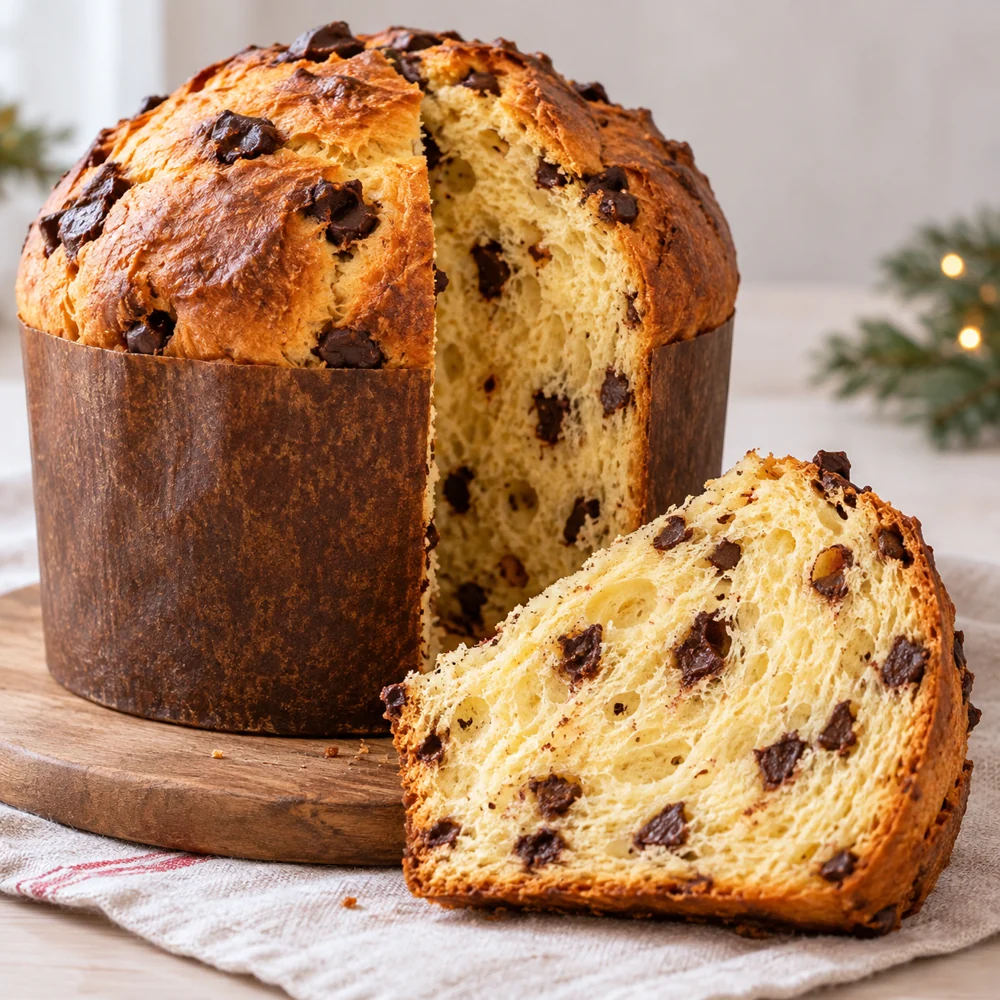
Panettone with chocolate chips
Prepare a homemade baking panettone, topped with dark chocolate nuggets, with progressive kneading and baking in a high paper mold.
Kitchen Mode and Timer
Keep the recipe at hand during preparation.
Enables JavaScript to use the kitchen tools.
Visual Timer: Keeps this page open. It does not sound an alarm. The cooking remains to be monitored.
This homemade version uses baking yeast. It offers a garnished brioche, but does not present itself as a traditional Milanese panettone with natural leaven. The 1.5 kg paper mold leaves room for swelling.
Plan for several hours without trying to force the rise. The dough is rich in butter and eggs: the progressive kneading gives it its hold. The filling is added at the very end to preserve its shape and avoid coloring the whole dough.
That's all you need!
Equip me with a pack.If you miss something, choose your ingredients from Monoprix and your utensils on Amazon. Adjust the quantities to your guests, then uncheck what you already have.
Choose the number of guests and uncheck what you already have at home.
This sheet indicates a yield in parts or in weight. Specify your basis for calculating the races.
Your selection contains only the checked items. Check products and availability at Monoprix for ingredients, on Amazon for utensils.
Amazon Affiliate Links. As an Amazon Associate, I earn from qualifying purchases.
Your choices are memorized on this device.
The preparation step by step
Prepare ingredients and fruits
Weigh 450 g of strong bread flour, 8 g of dry yeast, 100 g of sugar and 5 g of salt. Cut the 140 g of butter into dice and keep the 10 g of butter from the top apart. Also prepare 200 g of dark chocolate chips. No additional dry fruit is provided in this version.
Prepare milk, eggs and aromas
Heat the 150 ml of milk to about 30 °C. Break the 3 eggs one by one in a bowl and beat them with a fork. Prepare 1 teaspoon of vanilla. Milk should remain warm, not hot; eggs and butter are at room temperature to facilitate their incorporation.
Check the instructions for use of the yeast
Read the indications of the dry yeast sachet. If it needs to be rehydrated, use some of the 150 ml of warm milk already measured and adhere to the indicated time; do not add milk. If it is intended for direct addition, simply mix it with flour. The milk should not be hot, as high heat would then prevent the dough from rising.
Mix the first crochet dough
Pour the flour, yeast and sugar into the bowl of the robot equipped with the hook. Add milk, beaten eggs, then 5 g of salt. Spin at a small speed until the flour is fully moistened. Stop the robot and scrape the walls with a spatula if flour sticks to the edge; butter will be added later.
Knead before adding fat
Continue kneading for about 10 minutes at slow or medium speed, following the limits of your robot. The dough must gather around the hook and gain elasticity, even if it remains sticky. Stop once to scrape the bottom and check that there is no dry flour left. Do not correct its flexibility by adding flour not provided in the recipe.
Add the butter three times.
Add about a third of the 140 g of soft butter and lets the hook incorporate it. When the pieces are almost no longer visible, add the second third and then the last one in the same way. Continue to knead for a total of 10 to 15 minutes for this phase. The dough goes through an irregular appearance, then must become smooth, flexible and shiny again.
Check elasticity before fruits
Stop the robot and take a small piece of dough between your fingers. Stretch it gently: it must be able to thin into a membrane before tearing, instead of breaking immediately into pieces. If it remains very brittle, knead for a few more minutes and check again. If the dough becomes frankly hot or oily, interrupt the kneading and let it cool off before resuming.
Spread the fruit and aromas
Add 200 g of dark chocolate chips and a teaspoon of vanilla. Crocheting at the slowest speed for 30 to 60 seconds, then ends with the spatula to distribute the trim without grinding it. The dough must have finished kneading before this addition; prolonging the kneading would crush the pieces.
Let double the dough
Let rise for about 2 hours in a room around 24 °C, away from drafts. Find the starting volume to follow the progress. The dough should almost double; a fresh kitchen or less active yeast may take longer. The actual swelling is the criterion to follow, not just the displayed duration.
Shapes a ball without tearing the dough
Place the 1.5 kg paper pan into a baking sheet. Remove the dough from the bowl with a spatula, then press gently to remove the larger bubbles. Bring the edges back to the center to form a ball and flip it over to place the joint underneath. Place it in the middle of the mold; do not pierce the paper with a sharp utensil.
Wait for the second rise
Cover without squeezing and let rise about 1 h 30 to 2 hours, until the top of the dough approaches 2 cm from the edge of the mold. Leave more time if necessary. Towards the end, preheat the oven to 170 °C, conventional oven setting (no fan), with an oven rack at the bottom and enough space above for the dome. Then move the plate gently so as not to drop the dough.
Incite and add butter from the top
Remove the cover. With the tip of a small sharp knife, draw a shallow cross on top, without pressing to the bottom. Place the 10 g of butter reserved in the center of this cross. These 10 g are in addition to the 140 g already incorporated into the dough; butter should not be taken back in a quantity already used.
Cuis and measure the temperature at the heart
Bake for 45 to 55 minutes at 170 °C. After about 25 minutes, if the dome is already well colored, cover it loosely with a sheet of baking paper. At about 45 minutes, insert a probe in the center of the brioche, without sticking it to the mold: aims at about 93 ° C. If the heart is less cooked, prolong in periods of 5 minutes by monitoring the color.
Cool before cutting
Take out the plate with oven gloves, then place the panettone, still in its paper mold, on a stable wire rack. Let it cool for at least 2-3 hours, until the heart is cold. Do not pack it yet and do not cut it hot, because the crumb would be fragile. This yeast recipe gives a high brioche; it is not presented as a traditional panettone long fermented with leaven.
Cut parts without tamping the crumb
Cleanly spread or cut the paper around the area you want to slice. Place the brioche on a board and use a bread knife in gentle back-and-forth movements. Hold the side with your hand without pressing the dome. Packs the rest once fully cooled to limit drying.
Conservation. Store 2 days in an airtight box, after full cooling. Freeze in portions for up to 1 month for longer storage.
Recipe proposal with quantities and step by step. Times vary depending on the material: follow also the markers of texture and cooking.
The benchmarks for success
Cover the pieces
Prepare the filling in separate pieces and incorporate it only when the dough is already elastic. Do not add syrup or preservatives.
Respect the texture
Stop mixing, lifting or cooking at the mark described in the step by step. The indicated time remains an estimate: the temperature of the room and the power of the oven can change it.
Packs only cold
Let the indicated cooling finish before stowing. A box closed too early traps the steam and softens the surface.
Questions Before You Start
Should the nuggets be melted?
Nope. Fold in 200 g of solid nuggets at cool room temperature. Melted chocolate would change the whole dough and erase the visible pieces in the slice.
Is it a traditional sourdough panettone?
This recipe uses yeast. It gives a homemade brioche in high mold; the version with natural leaven requires another formula and a calendar over two days.
When should I add the trim?
Add the chocolate chips after kneading, at a very slow speed, and then finish at the spatula. A long action of the hook would break the pieces.
Baking tips for this recipe
- Weigh the yeast and uses the type indicated in the recipe: yeast and yeast are not interchangeable.
- Observe the increase in volume during shoots. A cool room can lengthen the times indicated.
- Respect the dimensions of the mold and the amount of dough: a brioche too tight or too full does not cook in the same way.
Substitutions and variations
To replace a main ingredient, choose another sheet designed with the one you want to use. Changing the proportions of fat, sugar or liquid can change the hold of the dessert.
Keep the type of chocolate provided for the structure or ganache. Switching from dark chocolate to white chocolate changes the balance: the quantities do not transpose directly.
More treats for your Christmas table
Recipes that share ingredients or the same preparation family.