
THE FESTIVAL CARNET
Homemade Sourdough Panettone
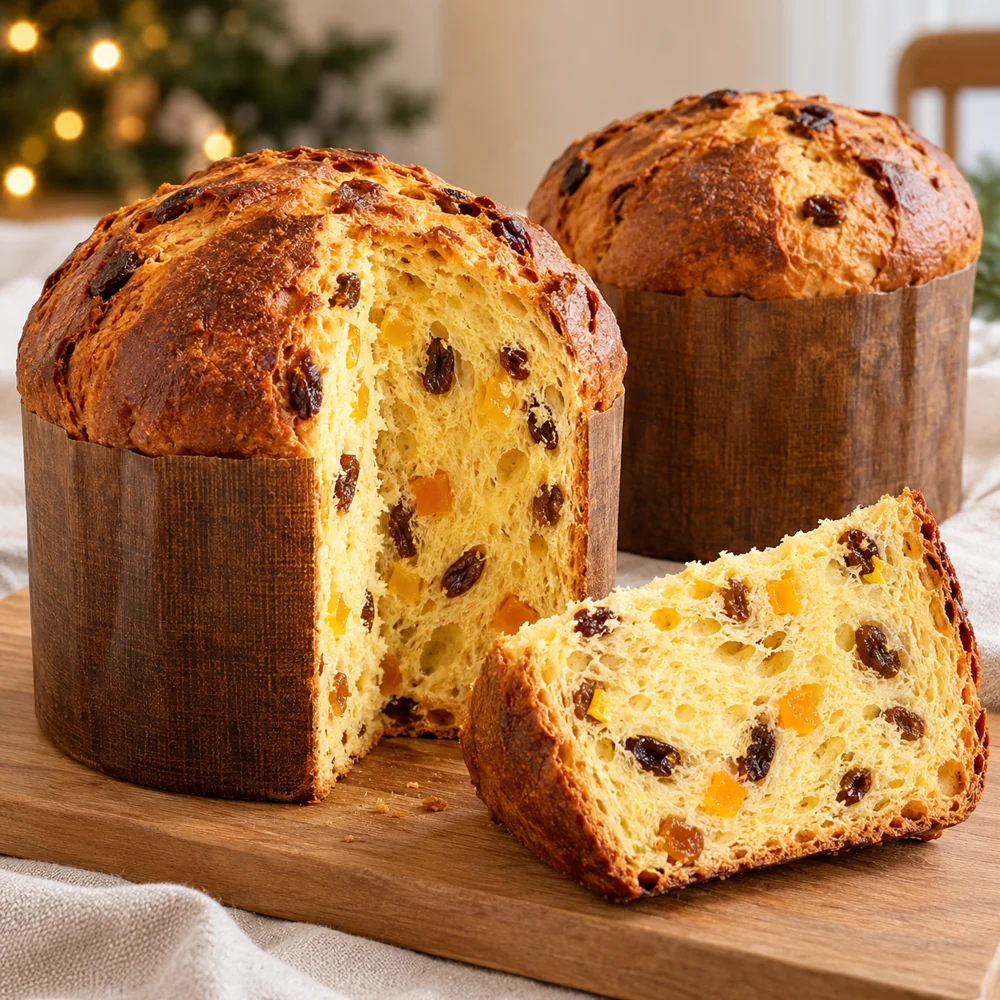
A firm sourdough panettone, raisins and candied citrus: three refreshed, two successive pastas and a suspended cooling to be organized over two days.
Kitchen Mode and Timer
Keep the recipe at hand during preparation.
Enables JavaScript to use the kitchen tools.
Visual Timer: Keeps this page open. It does not sound an alarm. The cooking remains to be monitored.
The natural leaven panettone requires time and a very active firm leaven. Allow two days and one night of cooling. This recipe is for a person already used to sourdough; the yeast version of the notebook is more accessible to start.
The number of hours is an order of magnitude. The three refreshed, the tripling of the first paste and the molded shoot are distinct steps. For an approach with organic ingredients, choose products bearing the certifications you are looking for; the recipe itself does not constitute a label.
That's all you need!
Equip me with a pack.If you miss something, choose your ingredients from Monoprix and your utensils on Amazon. Adjust the quantities to your guests, then uncheck what you already have.
Choose the number of guests and uncheck what you already have at home.
This sheet indicates a yield in parts or in weight. Specify your basis for calculating the races.
Your selection contains only the checked items. Check products and availability at Monoprix for ingredients, on Amazon for utensils.
Amazon Affiliate Links. As an Amazon Associate, I earn from qualifying purchases.
Your choices are memorized on this device.
The preparation step by step
Check the leaven and the material
This advanced recipe requires an already established firm sourdough, not a beginning liquid sourdough or baker’s yeast. It must have a sweet smell and rise regularly. Prepare two 750 g paper molds, two pairs of solid pins for panettone, a crochet robot and a probe. Check before starting that the pins can hold horizontally between two stable brackets.
Feed the starter three times using the measured quantities
Mix 20 g of leaven, 40 g of strong bread flour and 20 g of water. Keep at 26-28 °C until it almost triples, often 3 to 4 hours. Take 20 g of this leaven and add 40 g of flour and 20 g of water again; wait for the same development. At the third refreshed, mix 30 g of the previous leaven, 60 g of flour and 30 g of water. Use 90 g when it is well inflated. Unused portions do not go into the dough.
Prepare the first kneading
Dissolve 70 g of sugar in 120 g of water. Pour into the vat with the 260 g of flour, then mix at a small speed until the dough is collected. Add the 90 g of firm leaven into small pieces. Kneaded 8 to 10 minutes by scraping the walls at a standstill; the dough begins to stretch.
Add the egg yolks and butter alternately
Weigh the yolks after separating the eggs: keep exactly 60 g for this dough. Stir them in three additions, then 90 g of soft butter in four small additions. Wait for absorption before continuing. The paste should form a thin membrane when stretching a piece of it. Do not look for this result by letting the robot heat up: interrupt for a few minutes if the dough exceeds 28 °C.
Let the first paste triple
Place in a straight container and mark the starting level. Cover and then keeps around 26 °C, usually 10 to 14 hours, up to a volume close to triple. The volume marker counts more than the duration. If the dough has not developed, do not continue with a second dough loaded with butter and fruit.
Prepare fruit and second paste
Drain and dry the raisins if they have been rinsed; no free water should remain. Weigh 120 g of raisins, 70 g of candied orange and 30 g of citron. Weigh the 50 g of yellows from the second paste. Slice the vanilla pod and scrape the seeds within 20 g of honey.
Strengthens the fermented dough
Put all the first dough in the robot with the 110 g of flour. Knead gently for 5 to 8 minutes until a smooth paste is found. Add the 40 g of sugar in two, then the 50 g of yellows little by little. Add 5 g of salt and vanilla honey. Scrape the bottom to leave no area of flour dry.
End the enrichment
Stir in 60 g of soft butter in four times, then 20 g of water in small spoonfuls, waiting for absorption. The dough becomes shiny and supple, while keeping an extensible membrane. If it tears or heats up, stop and let it cool for a few minutes; do not make up for any unplanned flour.
Spread the fruit
Add raisins, orange and citron and mix 30 to 60 seconds at very low speed. Finish by folding with a spatula to preserve the pieces. Spread the dough on the slightly buttered worktop with a trace taken from the 10 g of butter at the top. Let stand for 20 minutes covered.
Stable two-piece shape
Weigh the dough and divide it into two equal parts, about 600 g each. Gently bring the edges towards the center and then turn each piece and rotate it with your hands to stretch the surface. Place in the two paper molds of 750 g, themselves placed on a plate. The smooth part remains at the top.
Wait for the last push
Cover without squeezing and leaves to rise around 26 °C for about 4 to 8 hours. The dough must arrive at 2 cm from the edge of the paper. Remove the lid for the last 15 minutes to slightly dry the top. Preheat the oven to 170 °C, conventional oven setting (no fan), and prepares the cooling racks.
Incise and cook to heart
With a very clean blade, make a small superficial cross on each top. Spread the remaining summit butter over the two crosses. Bake in the bottom of the oven for 40-50 minutes. At about 40 minutes, control with a probe: aims at 94 °C in the center. Cover from baking paper if the surface is turning too fast.
Returns immediately and cooled
From the exit, pass two pins adapted in the base of the paper of each panettone, about 2 cm from the bottom, then return with the protected hands. Lay the ends of the pins on the verified supports so that the pieces hang without touching the plane. Let it cool for 8 hours. Mounting must be stable and out of reach of children.
Cut the next day
When the heart is cold, return to the place and remove the pins. Cut with a bread knife without crushing the crumb. This sourdough method belongs to the traditional family of panettone, but the proportions proposed are a domestic adaptation, without Milanese certification or promise of professional result.
Conservation. Keep for 3 days after full cooling. Freeze slices for up to 1 month; long fermentation does not prove long shelf life at room temperature.
Recipe proposal with quantities and step by step. Times vary depending on the material: follow also the markers of texture and cooking.
The benchmarks for success
Respect the texture
Stop mixing, lifting or cooking at the mark described in the step by step. The indicated time remains an estimate: the temperature of the room and the power of the oven can change it.
Cool in suspension
Check the pins and their supports before kneading. The two panettones must cool turned over for 8 hours, without touching the worktop.
Questions Before You Start
Can I replace firm leaven with liquid leaven?
Not on equal weight. This formula is based on a leaven with 50% hydration, refreshed three times; a liquid leaven changes the amount of water and fermentation.
The first paste does not triple: should we continue?
Wait for the expected development before the second paste. An insufficiently active leaven does not support the new additions of sugar, butter and fruit; an elapsed time does not replace the mark of volume.
How long do I need to book?
Allow two days: three refreshed, a first fermentation of 10 to 14 hours, a final shoot of 4 to 8 hours and 8 hours of cooling. The posted rest is an intermediate estimate, not a guaranteed schedule.
Baking tips for this recipe
- Preheat the oven according to the plug and prepare the mold before mixing the last ingredients.
- Uses the dimensions and cooking mode indicated: a higher or wider mold changes the cooking of the center.
- Follow the visual cues of step by step in addition to the duration. Respect the intended cooling before unmoulding or decorating.
Substitutions and variations
You can choose a sweeter or more full-bodied honey, keeping the indicated amount. Replacing honey with dry sugar, on the other hand, requires a review of the recipe.
Blond or brown raisins can be used at the same weight; retains the soaking step when it is planned.
More treats for your Christmas table
Recipes that share ingredients or the same preparation family.