THE FESTIVAL CARNET
Reims-Inspired Rye Gingerbread
A house version entirely in rye, honey and spices, to let cool for a long time for a clean cut.
Kitchen Mode and Timer
Keep the recipe at hand during preparation.
Enables JavaScript to use the kitchen tools.
Visual Timer: Keeps this page open. It does not sound an alarm. The cooking remains to be monitored.
A house version entirely in rye, honey and spices, to let cool for a long time for a clean cut.
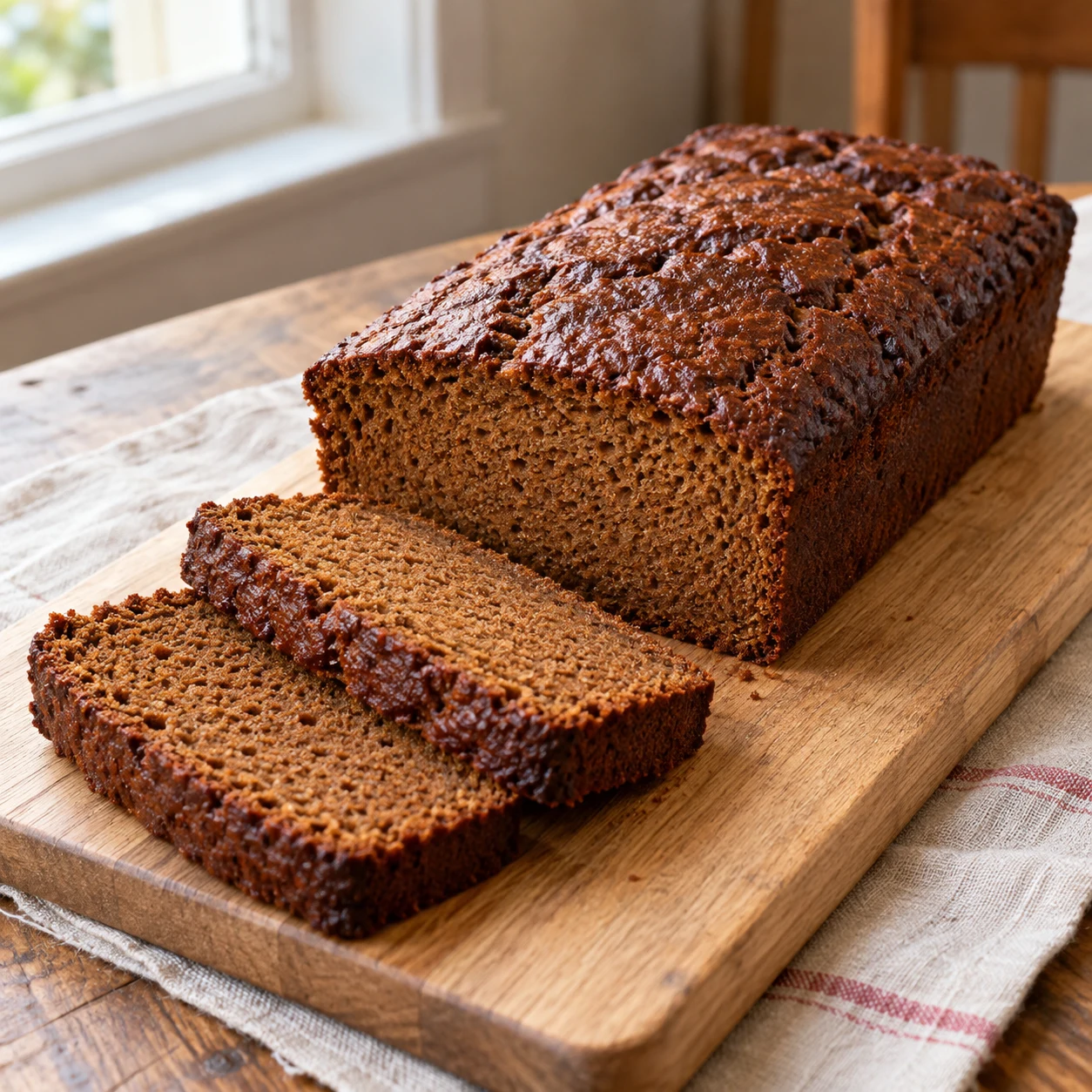
The goal is a homemade gingerbread: a slightly bulging crust, a crumb that stands and a clear flavour, without complicated decoration. The proportions below correspond to a single mold, and the ingredients of this variant replace those of another formula: does not cumulate several recipes.
The preparation is done with a manual whisk. The cooking time is indicative; complete cooling is part of the job and avoids breaking still fragile slices.
This homemade recipe evokes Reims gingerbread in rye without claiming a precise professional recipe. The current products differ according to the houses; there are also versions mixing wheat, rye and eggs.
That's all you need!
Equip me with a pack.If you miss something, choose your ingredients from Monoprix and your utensils on Amazon. Adjust the quantities to your guests, then uncheck what you already have.
Choose the number of guests and uncheck what you already have at home.
This sheet indicates a yield in parts or in weight. Specify your basis for calculating the races.
Your selection contains only the checked items. Check products and availability at Monoprix for ingredients, on Amazon for utensils.
Amazon Affiliate Links. As an Amazon Associate, I earn from qualifying purchases.
Your choices are memorized on this device.
The preparation step by step
Prepare and weigh the ingredients
Read the whole recipe, then weigh 250 g T130 rye flour, 8 g baking powder, 5 g sweet four-spice, 1 g salt. In another container, gather 250 g of liquid honey, 170 ml of water. Also prepare a clean bowl and a spatula. Keep the dry ingredients separate from the liquid so that no measured ingredient is missed.
Line the mold and heat the oven
Cut baking paper wide enough to line the base of the 24 × 10 cm tin and overhang its two long sides. Add two small rectangles to the ends. The paper is enough here, without extra fat. Position a rack in the middle of the oven and preheat to 160 °C, conventional setting (no fan).
Fluidizes the honey without boiling it
Pour 250 g of liquid honey, 170 ml of water into the pan. Heat on very low heat for 3 to 5 minutes, stirring and scraping the bottom. As soon as the honey mixes with the liquid, remove the pan. The mixture should be homogeneous and fluid, not bubbling.
Let the liquid cool down
Remove the pan from the heat for about 10 minutes, stirring two or three times. If you use a thermometer, wait for a temperature below 40°C. This prevents the flour from being heated abruptly. Prepare the dry ingredients while the mixture cools; this time is already included in the stated resting time.
Spread the baking powder and spices
Pour into the bowl 250 g of T130 rye flour, 8 g of baking powder, 5 g of sweet four-spice, 1 g of salt. Whisk the dry ingredients together for 30 seconds. Crush any small lumps of baking powder with the back of a spoon. If the flour is very lumpy, sift it before combining the ingredients.
Check the preparation without eggs
This formula does not require an egg: does not add any to correct the appearance of the liquid. Scrape the walls of the pan and stir one last time to bring all the honey back into the mixture. Prepare the mould next to the bowl to bake quickly after adding the baking powder.
Gather the two preparations
Make a well in the centre of the dry ingredients. Pour in a third of the lukewarm liquid and whisk from the centre, gradually drawing in the flour. Add the rest in two additions. Scrape the bottom of the bowl with a spatula and stop once the batter is evenly mixed. It should be thick but spread slowly when it falls from the spatula.
Check the dough before pouring
Scrape the bottom and sides of the bowl with a spatula to check that no pockets of flour remain. Stop once the mixture is evenly combined with no dry ingredients remaining. Do not add flour to stiffen the batter or beat it for several minutes: this cake does not need air whisked into it.
Fill and even the mold
Pour the batter into the tin, scraping the bowl thoroughly. Spread into the corners and lightly smooth the top with the back of a spoon. Fill no higher than two-thirds of the tin. If your tin is smaller than specified, bake the excess in a separate small tin.
Cook slowly
Bake in the middle of the oven for about 60 minutes at 160°C. Do not open for the first 35 minutes. Begins to control 55 minutes after charging. If the crust browns too much before the centre is baked, cover loosely with baking paper, keeping it away from the heating element.
Check the cooking and then removes
Insert a skewer into the centre at the highest point. It should come out without wet batter; a few moist crumbs are normal. Bake for another 5 minutes and check again if needed. Use oven gloves to remove the tin. Wait 15 minutes, then lift the cake out by the baking paper and place on a wire rack.
Cool before cutting
Peel the paper away from the sides and leave the gingerbread to cool for about 2 hours. The underside must be cold too. Cut slices 1.5 to 2 cm with a bread knife, making small back and forth movements without pressing the top. If you keep it for the next day, pack it only when it's cold.
Conservation. Let it cool completely, then keep the cake 3 days in an airtight box, in a cool and dry room. For longer storage, freezes slices packaged separately; defrosts only the useful amount. It is not a long-lasting product.
Recipe proposal with quantities and step by step. Times vary depending on the material: follow also the markers of texture and cooking.
The benchmarks for success
Choose the right mold
The indicated format counts as much as the temperature. In a shorter, deeper mold, the heart will cook more slowly; in a very large mold, the crumb will dry faster. Keep at least 3 cm free under the edge and cook any surplus separately.
Mixing just what is needed
Once the flour is moist, stop the whisk as soon as the white piping bag have disappeared. A long mixture does not make this cake lighter and can tighten its crumb. Especially the bottom of the bowl with the spatula.
Judge cooking at heart
The color of the ingredients and the material of the mold change the browning. A dark crust does not prove that the center is cooked: always check with a spike planted in the thickest part.
Questions Before You Start
Can we prepare it the day before?
Yeah. Wait until the cake is cold before packing. One night helps the crumb to cut and let the aromas spread; it does not allow to keep it for several weeks.
Why does the center seem sticky?
A hot cut cake may look gummy. Let it cool completely. If there is some shiny paste left on the skewer during the oven control, extend the cooking in sequences of 5 minutes before taking it out.
Do I need to add an ice cream?
Nope. The recipe and its illustration present the cake without icing. The dough already brings its fragrance; serve the cake as is, once completely cooled.
Baking tips for this recipe
- Preheat the oven according to the plug and prepare the mold before mixing the last ingredients.
- Uses the dimensions and cooking mode indicated: a higher or wider mold changes the cooking of the center.
- Follow the visual cues of step by step in addition to the duration. Respect the intended cooling before unmoulding or decorating.
Substitutions and variations
You can choose a sweeter or more full-bodied honey, keeping the indicated amount. Replacing honey with dry sugar, on the other hand, requires a review of the recipe.
More treats for your Christmas table
Recipes that share ingredients or the same preparation family.