If you miss something, choose your ingredients from Monoprix and your utensils on Amazon. Adjust the quantities to your guests, then uncheck what you already have.
Choose the number of guests and uncheck what you already have at home.
Original quantity: 8 people.
This sheet indicates a yield in parts or in weight. Specify your basis for calculating the races.
Visual Timer: Keeps this page open. It does not sound an alarm. The cooking remains to be monitored.
Read the recipe and weigh the ingredients
Make room in the refrigerator for the serving plate. Weigh each group of ingredients separately: keep the decoration chocolate separate from the chocolate for the ganache. Cut a sheet of baking paper to the dimensions of the baking tray, with a small edge. Prepare a second sheet of baking paper for turning out the sponge. Cooling stages can overlap; never fill a warm sponge with cream.
Prepare the ganache first
Chop the 200 g of dark chocolate and put them in a dry bowl. Pour the 200 g of cream into a saucepan and heat until the first small bubbles around the edge. Remove from the heat. Pour a third of the cream over the chocolate, wait 30 seconds and then stir with a spatula in small circles in the center. Add the second third and then the last in the same way. The mixture should become smooth and glossy, with no lumps. Do not whisk it.
Let the ganache become spreadable
Pour the ganache into a large container, press cling film directly onto the surface and let cool for about 20 minutes. Then place it in the refrigerator for 30 to 60 minutes, stirring every 10 to 15 minutes. It should hold on the spatula but spread easily without tearing the sponge. If it is runny, chill it longer; if it becomes too firm, leave it at room temperature for a few minutes. Times vary depending on the chocolate.
Preheat the oven and crack the four eggs
Preheat the oven to 180 °C, conventional setting (no fan). Position the oven rack in the middle. Break the 4 eggs one by one in a small bowl to easily remove any shell, then pour them into the large bowl. Add 100 g of sugar and a pinch of salt. It is not necessary to separate the whites from the yolks.
Whisk to the ribbon stage
Beat the eggs and sugar with an electric mixer for 7 to 10 minutes. The mixture should become pale and increase significantly in volume. When you lift the beaters, the falling batter should leave a visible trail on the surface for a few seconds: this is the ribbon stage. If it disappears immediately, whisk for another minute before checking again.
Fold in the dry ingredients without deflating the mixture
Sift the 100 g flour over the bowl in three additions. After each addition, slide the spatula down to the bottom, lift the batter over the top and turn the bowl slightly. Do not use the whisk again. Stop as soon as no pockets of flour remain, checking the bottom of the bowl too. Immediately spread the batter evenly over the entire 30 x 40 cm tray, including the corners.
Bake until set but still flexible
Bake for 10 to 12 minutes. Check after 10 minutes: the surface should be set and spring back slightly when touched, with no wet batter. An overbaked sponge will crack when rolled. Use oven gloves to remove the tray. Rest for a minute, then turn the sponge out onto the second sheet of baking paper. Gently peel off the original baking paper, pulling it back almost flat.
Roll up the warm sponge
With the 30 cm side facing you, make a small initial fold, then roll the warm sponge along its 40 cm length. For this initial roll only, keep clean baking paper between the layers to prevent sticking. Place the roll seam-side down and cool for 25 to 30 minutes. It should be at room temperature before adding the ganache.
Fill and roll without paper inside
Use 300 g ganache for the filling and reserve about 100 g for assembly. Gently unroll the cooled sponge, peeling away the paper as you go. Spread the filling, leaving 1 cm clear at the edges and 2 cm at the closing edge. Roll up again using the paper underneath to guide it, keeping the paper outside the cake this time. Place seam-side down, wrap and refrigerate for 45 to 60 minutes.
Make the milk chocolate bark
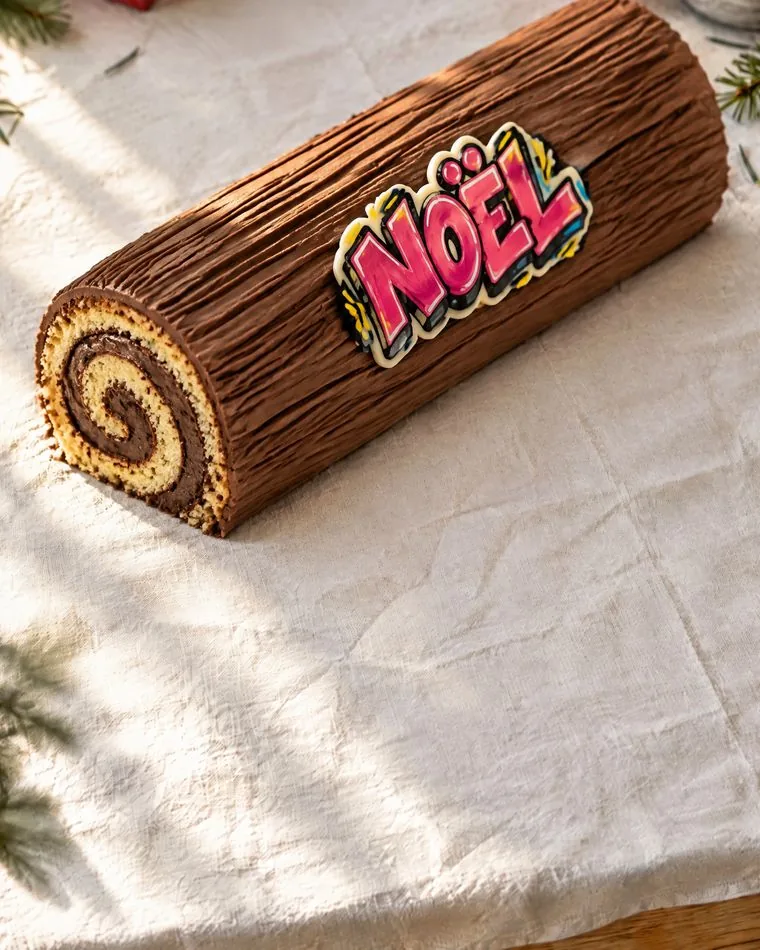
Chop the 150 g of milk chocolate in a bowl. Bring the 100 g cream to a gentle simmer and pour over the chocolate in three additions, stirring from the centre. Let cool and thicken for about 30 minutes, until soft. Cut only the irregular ends of the cold log. Spread this coating on the top and sides with a small spatula, keeping the spirals of the ends visible.
Add the bark texture
Before the coating sets, draw a fork lengthways through it without pressing down to the sponge. Make a few slightly wavy lines; the pattern need not be perfectly regular. Wipe the fork clean between strokes. Put the log back in the refrigerator while the tag is being prepared.
Make the white chocolate plaque
Draw a rounded rectangle of 12 x 5 cm on a sheet of paper, then cover it with baking paper so that the ink does not touch the food. Melt the 80 g of white chocolate in a mild bain-marie, in a dry bowl without contact with water. Remove as soon as small pieces remain and mix off the heat. Set aside 50 g in a bowl. Use only enough to fill the template to a thickness of 2 to 3 mm. Let any surplus chocolate set on baking paper for reuse. Leave the plaque flat to set for 15 to 20 minutes in a cool room, or a few minutes in the refrigerator. Do not cut chocolate once it is completely hard.
Write and outline the graffiti
Divide the remaining 30 g of white chocolate into three small bowls, for example 20 g for pink and 5 g for each other color. Mix a tiny amount of fat-soluble food colouring into each bowl; water-based colouring would make the chocolate seize. Using a small piping cone, write NOEL in four large, simple letters on the set plaque. Add two or three yellow and blue lines around it. Melt the 20 g of dark chocolate separately, leave to cool and then draw a fine outline. A few strokes are enough; there is no need for the precision of a printed design.
Attach the plaque and serve
Wait until the design is firm enough to touch without leaving a mark. Release the plaque by peeling the paper away underneath, without pulling on the chocolate. Place three small dots of the reserved ganache on the log and press the plate very gently against the side. Keep it cold for 20 to 30 minutes. Before serving, remove the plaque to share separately, then slice the log with a long knife, wiping it between slices.
Storage and serving
Keep the log in a box in the refrigerator and consume it within 48 hours. Take it out for about 15 minutes before serving. Lay fragile decorations at the last moment; do not leave the cream for several hours at room temperature.
Recipe proposal with quantities and step by step. The times are indicative. The video and images illustrate a creation; hand-crafted sets can be simpler.
Baking tips for this recipe
Chop the chocolate into regular pieces to facilitate its melting on contact with the cream.
Mix in the center and gradually widen the gesture to obtain a smooth ganache, without unnecessarily incorporating air.
Respect the indicated rest and temperature of use: a warm, soft or cold ganache does not work in the same way.
Substitutions and variations
To replace a main ingredient, choose another sheet designed with the one you want to use. Changing the proportions of fat, sugar or liquid can change the hold of the dessert.
Keep the type of chocolate provided for the structure or ganache. Switching from dark chocolate to white chocolate changes the balance: the quantities do not transpose directly.
More treats for your Christmas table
Recipes that share ingredients or the same preparation family.
 01 / The Creation