
THE FESTIVAL CARNET
Christmas log with praline paste and hazelnuts
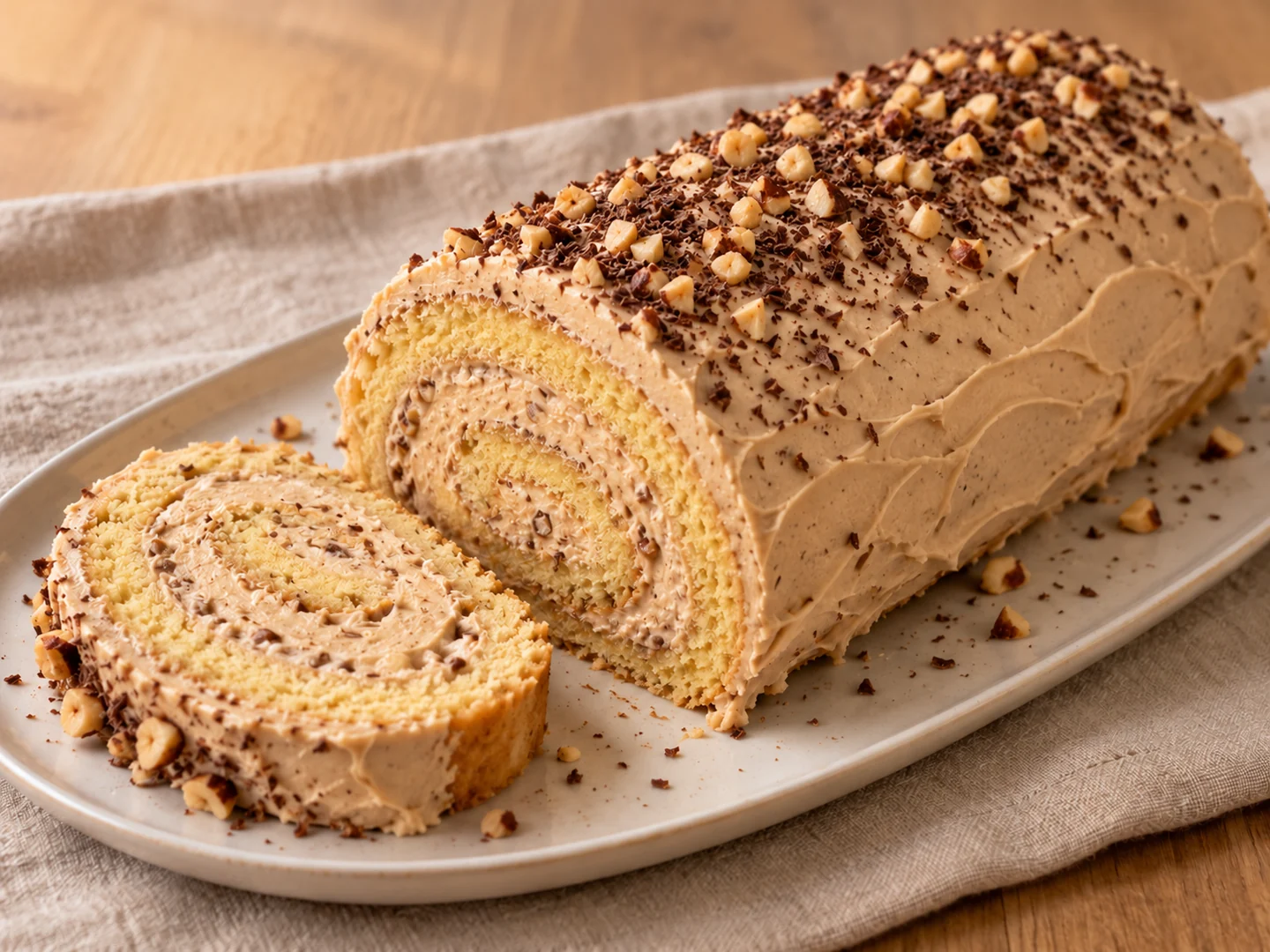
A log rolled with hazelnut praline paste, with an easy mascarpone cream, crushed hazelnuts and a spatula cover.
Kitchen Mode and Timer
Keep the recipe at hand during preparation.
Enables JavaScript to use the kitchen tools.
Visual Timer: Keeps this page open. It does not sound an alarm. The cooking remains to be monitored.
The praline paste combines nuts and caramelized sugar in a smooth paste. In this Christmas log, he perfumes a mascarpone cream that garnishes and covers the sponge. Some crushed hazelnuts provide a crisp contrast, without adding foil, toffee or frozen insert.
Choose a hazelnut praline paste, or a mix of almonds and hazelnuts, ready to use. An unsweetened hazelnut puree and grains of pralin would not give the same garnish. The roll is prepared on a standard plate of 30 x 40 cm and then rests in the refrigerator. The decor remains low and simple: traces of spoon, fragments of hazelnuts and a little grated dark chocolate.
That's all you need!
Equip me with a pack.If you miss something, choose your ingredients from Monoprix and your utensils on Amazon. Adjust the quantities to your guests, then uncheck what you already have.
Choose the number of guests and uncheck what you already have at home.
This sheet indicates a yield in parts or in weight. Specify your basis for calculating the races.
Your selection contains only the checked items. Check products and availability at Monoprix for ingredients, on Amazon for utensils.
Amazon Affiliate Links. As an Amazon Associate, I earn from qualifying purchases.
Your choices are memorized on this device.
The preparation step by step
Prepare the plate and eggs
Preheat the oven to 180 °C in conventional oven setting (no fan). Tapes the 30 x 40 cm baking paper. Melt the 20 g butter and allow it to cool until lukewarm. Break each egg into a small bowl; separate the white from the yolk by passing the yolk between the half shells. Gather the four whites and four yolks in two bowls.
Whisk both preparations
Whisk the four yolks with 70 g of sugar for 3 minutes: the mixture must fade and thicken. Using clean beaters, whisk the four egg whites with the salt, then add the remaining 30 g sugar in three additions. Stop when the foam forms a soft peak at the end of the whisk, without becoming dry or lumpy.
Finish and spread the dough
Fold in a third of the whites to the yolks to soften them. Add the other whites and 100 g of sifted flour in two, with a spatula running from the bottom to the top. Mix two spoonfuls of lukewarm butter dough, then pour this mixture back into the bowl. Regularly spreads over the entire plate, right down to the corners.
Monitors the baking of sponge
Bake at mid-height for 10 to 12 minutes, without opening for the first 8 minutes. The sponge should be slightly golden, soft under one finger and no longer leave wet dough. Take it out as soon as these benchmarks are combined: a prolonged cooking dries this thin layer and makes rolling more difficult.
Preroll and let cool
Spread the dish clean, moistened and then very well wrung, on the worktop. Turn the hot sponge over, baking tray removed, then gently peels off the baking paper. Roll the sponge immediately with the tea towel, starting from a side of 30 cm. Let it cool for 30 minutes as well: the future log will be about 30 cm long.
Prepare praline paste and hazelnuts
Stir the 120 g of praline paste in their jar before weighing them, as the oil can rise to the surface. Crush the 40 g of hazelnuts with a knife on a stable board. Keep 20 g for trim and 20 g for decor; aims for small chips that are easy to cut, without reducing them to powder.
Whisk the cream with mascarpone
Pour 250 g of mascarpone and 150 g of liquid cream into a cold bowl. Whisk at medium speed, until the cream forms furrows and holds on to the whisk. Add the 120 g of praline paste to the spatula, in small portions, then mix gently until a uniform beige color is obtained.
Garnish the sponge with praline paste
Reserve about 170 g of cream for the outside and keep them cool. Unroll the cold sponge, remove the tea towel and spread the remaining 350 g of cream. Leave 2 cm free on the last edge of 30 cm. Spread the 20 g of hazelnuts intended for the interior in a thin layer, without clumps.
Roll without compressing the trim
Start rolling by the small side opposite the edge left free. Lift the tea towel to guide the biscuit and accompany the first round with your hands, without pressing on the hazelnuts. Finish with the closure underneath, then lay the log on its plate. If a little cream comes out, get it back with a spoon.
Refrigerate before covering
Cover the log without touching its surface and place it in the refrigerator for at least 2 hours. Keep the reserved cream in a covered bowl, also in the refrigerator. This rest gives strength to the roll: you can then spread the cover without moving the layers of sponge or bring out the garnish at the ends.
Finish the praline paste decor
Spread the 170 g of reserved cream on the top and sides with the back of a spoon. Just draw a few broad waves. Sprinkle the remaining 20 g of hazelnuts, then graze the 20 g of dark chocolate above the center. Keep cold until service and cuts with a clean blade between each slice.
Conservation. Keep the log covered in the refrigerator, at 4 °C maximum, for 48 hours. Add the hazelnuts of the decor on the day of the service to preserve their crunchiness. Take out only the necessary parts when serving.
Recipe proposal with quantities and step by step. Times vary depending on the material: follow also the markers of texture and cooking.
The benchmarks for success
Read the label of praline paste
It takes a paste of nuts and sugar, without large pieces. Its taste and sugar content vary by brand.
Avoid the big splinters
Half-nuts inside could pierce the sponge. Instead, reserve small and regular pieces to make it easier to roll.
Madagascar vanilla and almond praline paste
For this variant, replace the 120 g of hazelnut praline paste with 120 g of almond praline paste and add the seeds of half a vanilla pod to the cream. Replace the 40 g of hazelnuts with 40 g of roasted almonds, coarsely chopped. Keep all other ingredients and gestures. Madagascar vanilla is an original choice, not a label assigned to the recipe.
Questions Before You Start
Can praline paste be replaced with praline paste?
Not directly: the pralin is granular and does not perfume the cream in the same way. Use a smooth praline paste.
Should I add sugar to the cream?
No, praline paste already provides sugar. This formula balances its sweetness with unsweetened mascarpone and cream.
How to get a log without almonds?
Choose a hazelnut-only praline paste and check for any traces on the label. The recipe always contains nuts.
Baking tips for this recipe
- Preheat the oven according to the plug and prepare the mold before mixing the last ingredients.
- Uses the dimensions and cooking mode indicated: a higher or wider mold changes the cooking of the center.
- Follow the visual cues of step by step in addition to the duration. Respect the intended cooling before unmoulding or decorating.
Substitutions and variations
To replace a main ingredient, choose another sheet designed with the one you want to use. Changing the proportions of fat, sugar or liquid can change the hold of the dessert.
Keep the type of chocolate provided for the structure or ganache. Switching from dark chocolate to white chocolate changes the balance: the quantities do not transpose directly.
More treats for your Christmas table
Recipes that share ingredients or the same preparation family.